








- The banking organisations are the institutions that great confidence generate between the Spanish to protect its details, according to a study of Sigma Two.
- This perception leans on the high security attributed to the digital banking, the confidence that they generate the companies in the protection of the personal details and its measures' optimistic assessment of cybersecurity.
- Bizum is had become the digital operations with which the Spanish sit down safer.
- The digital frauds are not caused within the perimeter of reinforced security of the digital banking, but instead via other digital service channels.
- Practically one half of the citizens recognises carry out digital administrative steps of way little person in charge or being aware of its potential danger.
In a context of high digitisation and increasing perception of the risk associated with the cyberattacks, the Spanish trust in the banking organisations when dealing with the digital scams. The banking organisations are the readiest institution and that great confidence generates, with a note of 7.1 on 10, between the Spanish of all the ages to protect its personal details, in front of Security Forces and Bodies of the State, the technological companies or the Public Administrations.
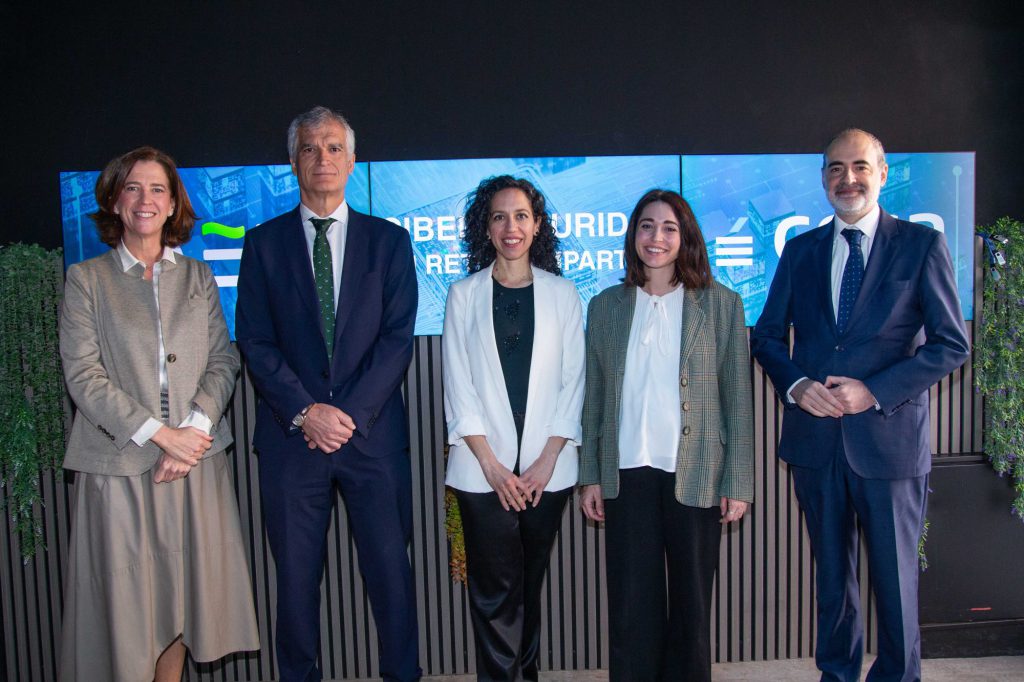
This assessment answers to the commitment that the citizens attribute to the banking with its personal details' protection and financial, and the high security of the digital banking, according to the “Opinion survey on cybersecurity”, elaborated by Sigma Two and presented this morning in the act ‘Cybersecurity, a shared’challenge, organised by the Spanish Banking Association (AEB) and CECA.
Thus, the vast majority of citizens considers that its bank worries for its personal details' security and financial, and they sit down insurance when using the digital banking. In addition, consider favourably measures of applied cybersecurity for its company to protect its confidential details.
The Spanish consider very positively the protection of the personal details that offer the banks, with a note of 7.3, and shows a rise of almost five percentage points, with respect to 2023, in the number of Spanish that they sit down insurance (a lot or enough) when operating with the digital banking. Bizum is had become the digital operations with which the Spanish sit down safer.
The digital frauds are not caused within the perimeter of reinforced security of the digital banking, clearly received by the users, but instead via other digital service channels more vulnerable: 65% of the Spanish recognises credit received fraudulent mails or SMS, 50% misleading calls and 25% contacts for social networks. The people over 65 years old are the age group with smaller cyberscams incidence.
In addition, the study reveals that the digital banking is internalised as an everyday service in the Spanish society, since 83.5% of the town it uses. In fact, according to has explained the Managing Director of Sigma Two, Rosa Díaz, “its use is situated above other digital as procedures administrative steps with the Public Administrations or the access to free”contents.
Six of each Spanish ten recognise no have sufficient knowledge with regard to cybersecurity, although a very similar percentage considers that adopts suitable protective measures. This supposes that many citizens believe be protected when, in practice, not is always thus: more than an another quarter does not adopt enough measures to protect its security, and more than a third of the young out of 18 and 29 years thinks wrongly that the bank can request keys or passwords via SMS, email or WhatsApp.
These details highlight the importance of following driving initiatives as those which develops the banking sector with regard to digital and education training financial: platforms as a Financial Classroom and Digital, that has a space of cybersecurity ad hoc , with immediate availability advice and initiatives, or awareness campaigns, as ‘In the digital thing, worry equal’, unfolded in social networks and media.
The chairwoman of the Spanish Banking Association (AEB), Alejandra Kindelán, has emphasised that “the cooperation between authorities, companies and institutions is essential. Nobody can address this challenge in recluse”. Furthermore, the Managing Director of CECA, Antonio Romero, has explained that “the digitisation is a beneficial transformation for the economy, but involves a series of challenges. The cybersecurity is crucial for the financial stability. Need ensure the confidence in cybersecurity so that the economic advances continue”.
In the event have also participated Ana Puente, General Assistant manager of Sustainable and Digital Finances; Carlos Sanz Luengo, Director of Fee-based systems of the Banco de España; Miriam Verde, General Secretary for INCIBE; Rosa Díaz, Managing Director of Sigma Two; and Elisa Espinosa, Sigma Research Director Two.