








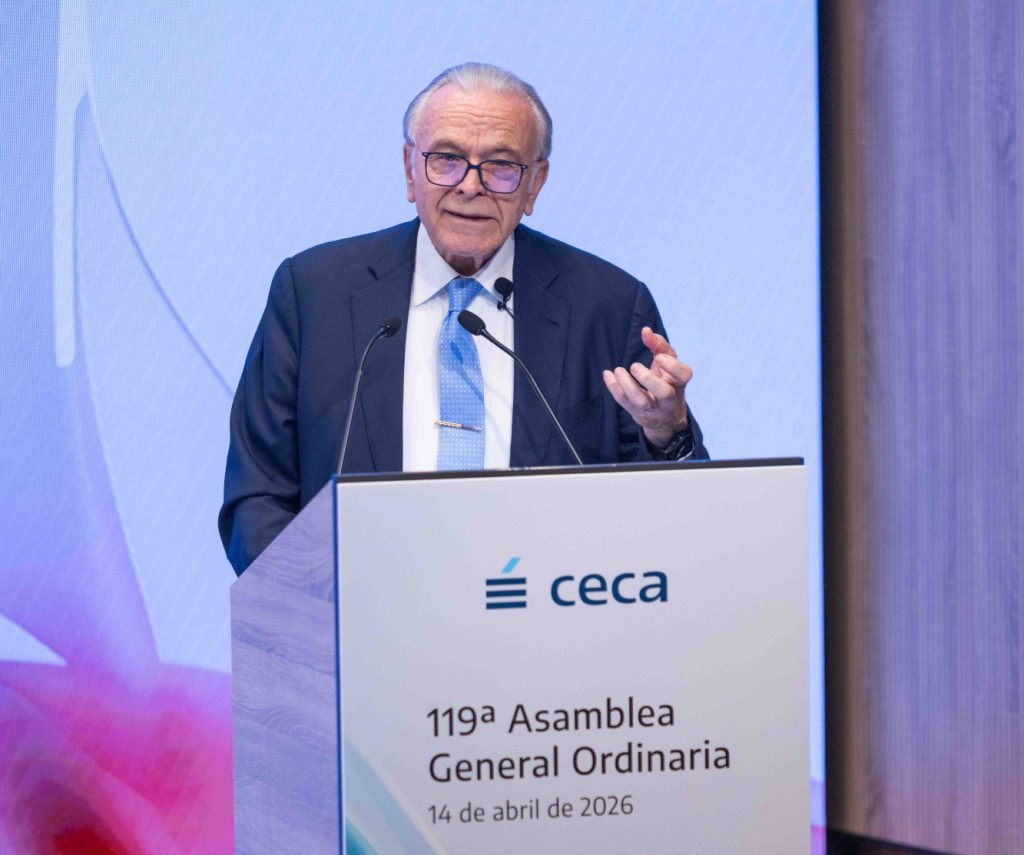
CECA has celebrated its 119ª General Assembly, in which have been highlighted the more than 1,000 million euros of investment in Obra Social reached in 2025, that they situate to its companies as the first social investor private of Spain
This resource has allowed carrying out more than 92,000 activities and has benefited to almost 36 million people
From the approval of the Act of Banking Savings banks and Foundations of 2013, the accumulated investment exceeds the 9,734 million euros
CECA has renewed its commitment with the improvement of the financial culture through the allocation of 5 million euros to the programme Funcas Educates
CECA has celebrated today its 119ª General Assembly, that it has been chaired by Isidro Fainé, CECA's Chairman, of the Fundación “la Caixa ” and of the Worldwide Savings Banks Institute and Retail Banks (WSBI, by its initials in English).
The meeting has included representatives of all the banks and savings banks that constitute the association and that represent around 40% of the Spanish financial system, as well as of chairmen and Managing Directors of the foundations associated with CECA, companies in charge of the design and the implementation of the Obra Social.
The Chairman of CECA has expressed during its intervention: “The Obra Social, from our origins, has been the seña of deeper identity of our sector. In 2025, the total investment in Obra Social in Spain already exceeded the 1,000 million euros. It is an emblematic figure that confirms to our companies as the private social largest investor of the country”.
In addition, has emphasised its commitment with the economic growth of the country, especially in the current context: “In a marked world for the geopolitical tension and the acceleration of the technological change, our companies still champion the core values that we have always maintained. Because we are a banking that listens and accompanies. An ingrained banking in the territory and committed to the people. A banking that promotes the financial inclusion. And are also a perfectly ready sector to lead the transformation of the banking business, on the basis of four major levers competitive: technological innovation, sustainability and respect for the environment, quality of service and some reliable long-lasting links with all the interest groups ”.
In the international realm, the Chairman of CECA has emphasised the solid collaboration and the shared values with the Savings Banks' European Association and Retail Banks (ESBG) and with the Worldwide Savings Banks Institute and Retail Banks (WSBI), underlining the importance of moving forward towards a stronger Europe, competitive and united.
The improvement of the competitiveness, a strategic priority for Europe
The Managing Director of CECA, Antonio Romero, has tackled the challenges and sector opportunities principals in an international marked context for the geopolitical tensions and the recrudecimiento of the commercial conflicts, emphasising the solidity of the Spanish financial system.
Romero has underlined “the need of strengthening the competitiveness of Europe through a regulatory simplification that allows a lither and efficient frame, able to promote the economic growth and strengthen the skills of the financial institutions to support to families and companies”.
With reference to the evolution of the Obra Social, Romero has celebrated the volume of investment, that exceeds the 1,000 million euros, a landmark that strengthens the commitment of the sector with the social cohesion, the boost of the research and the cultural and historic heritage protection of our country.
CECA has renewed, also, its commitment with the improvement of the financial culture through the allocation of 5 million euros to Funcas Educates, consolidating this programme as one of the initiatives principals of the sector to promote the company's financial education.
Foundations of the sector CECA consolidate its motivating role of the territories and the communities in Spain
In a previous way to the Assembly has taken place the Fee of Foundations and Obra Social, principal exchange forum of experiences, cooperation and study with regard to Obra Social. This is a statutory and advisory body of the association that brings together representatives of the sector's banking and ordinary foundations.
In this edition it has participated the Chairman of Cáritas, Manuel Briones, that it has explained a x-ray of the social exclusion in our country, which has served to frame the activity of the foundations CECA.
In 2025, the resource in Obra Social has ascended to 1,004.92 million euros, with which 92,858 activities have been carried out, that have benefited to 35.9 million people, especially belonging to groups in situation of vulnerability. From the approval of the Act of Banking Savings banks and Foundations of 2013, the accumulated investment exceeds the 9,734 million euros.
The Obra Social develops its activity in multiple areas, with the aim of responding to the main needs of the company and putting the focus in the people more vulnerable.
The Social Programs continue being the principal area of activity, with an investment of 362.9 million euros (36.12% of the total), set aside for initiatives aimed at reduce the poverty and the inequality, as well as to improve the living conditions of people. Les follows Culture and Assets, as second area with great resource, with 218.9 million euros (21.78%), focused on the access to the culture and the heritage conservation.
Below, emphasise the investments in Research, with 151.8 million euros (15.10%), centred mostly in health and science projects, and in Local Development, Employment and Enterprise, with 120.3 million euros (11.97%), set aside for support to SMEs, self-employed workers and the boost of the production network.
The rest of the complete areas the social activity of the sector, with 97.6 million euros in Education (9.71%), aimed at promote the financial training and culture; 27.5 million euros in Environment (2.73%) and 26 million euros in Sport (2.59%), contributing these last ones to the sustainability, the social cohesion and the promotion of healthy habits, as well as to the integration of vulnerable groups and the active aging.