


The banking sector launches a website to reinforce access to financial services
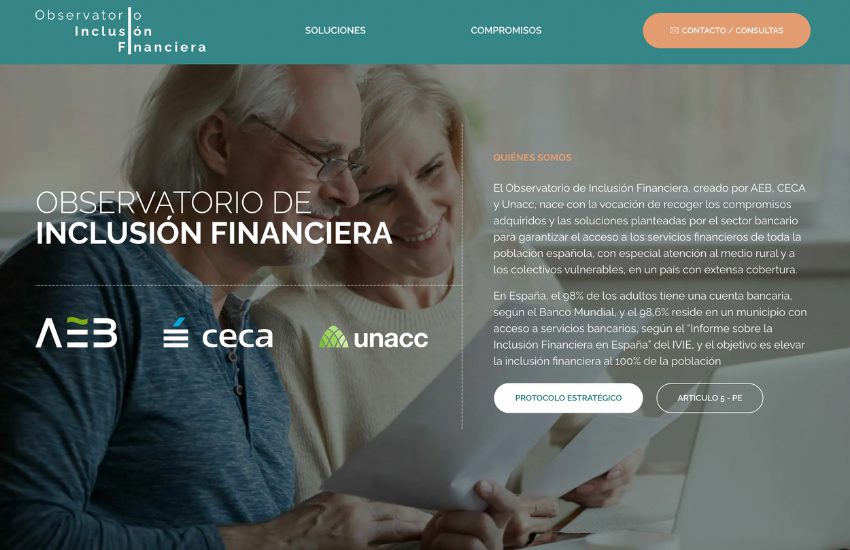
The associations AEB, CECA, and Unacc activate the website of the Financial Inclusion Observatory, which collects the measures adopted to ensure that the entire population has access to banking services
This new space compiles the actions implemented in accordance with the Strategic Protocol to Reinforce the Social and Sustainable Commitment of Banking
The Spanish Banking Association (AEB), CECA, and the National Union of Credit Cooperative Societies (Unacc) present today the website of the Financial Inclusion Observatory, which reflects the measures and agreements reached by the banking sector to increase access to financial services in Spain from the current 98% to 100% of the population.
With this new space, the banking sector reaffirms its commitment to ensuring financial inclusion, as outlined in point 5 of the Strategic Protocol to Reinforce the Social and Sustainable Commitment of Banking and its extensions, with special focus on rural areas and groups that require more personalized attention.
Spain has one of the densest banking networks in the European Union: it is the third country with the most access points per capita to financial services. 98% of adults have a bank account, and 98.6% reside in a municipality with access to banking services. In this context, the banking sector is deploying actions to facilitate 100% of the population’s access to banking services, through a framework of action with three pillars: inclusion in rural areas, inclusion of groups such as the elderly or those with disabilities, and inclusion through training.
To improve service in rural areas, banking associations have recently agreed on a roadmap with measures aimed at residents of municipalities that currently have no physical access point – and may have never had one – or only have one. Additionally, a collaboration agreement has been signed with Correos to facilitate access to cash in rural areas through the Correos Cash service.
This is complemented by a set of ten measures aimed at improving attention to older individuals or those with disabilities, with actions such as extended office hours, preferential treatment in face-to-face or telephone services, the adaptation of access channels such as websites or apps, and training measures for both employees and clients, based on their interests.
Regarding training, the banking sector dedicates extensive efforts to promote the acquisition of financial skills and digital competencies, complemented by the availability of the platform “Financial and Digital Classroom”, driven by AEB, CECA, and Unacc; a work recognized with the “Finance for All” award in 2022 awarded by the Bank of Spain, the CNMV, and the Ministry of Economic Affairs and Digital Transformation.
The website of the Financial Inclusion Observatory also provides information on tracking and updating these measures, forming part of the commitments made by the sector, and reflecting the persistence and priority given to this purpose of financial inclusion.