


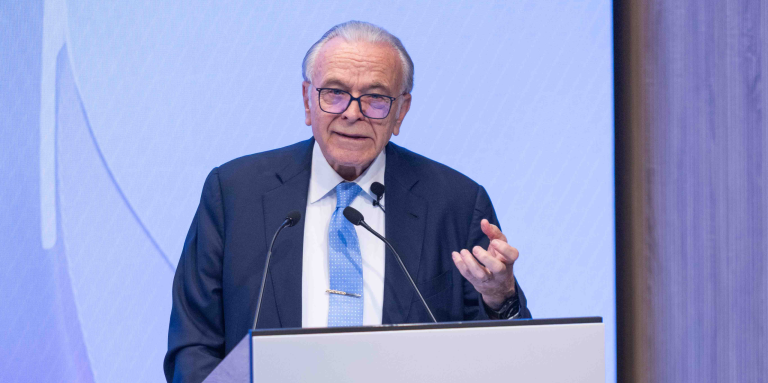
Isidro Fainé Promotes the Social Commitment of Savings Banks and Retail Banks Worldwide from Washington

The members of the World Savings and Retail Banking Institute (WSBI) have increased their resources aimed at social initiatives contributing to poverty reduction, youth empowerment, women’s entrepreneurship, care for the elderly, and environmental sustainability to nearly 4 billion dollars annually.
The president of the ‘la Caixa’ Foundation and the WSBI, Isidro Fainé, presided over the 34th General Assembly of the organization in Washington, which brings together retail banking from five continents, and its 4th Social and Philanthropic Council.
The president thanked them for their commitment and encouraged them to continue expanding it: “Investing in people, fostering trust, and acting purposefully are essential for a future that is economically viable and socially just.”
The WSBI also celebrated the first edition of its Awards to recognize the initiatives of its members towards inclusive, sustainable, and responsible banking.
During the Assembly, a new project was presented to promote rural employment for women in Nigeria, driven by the WSBI, the ‘la Caixa’ Foundation, and the Visa International Foundation, and a new strategic alliance was approved with the Food and Agriculture Organization of the United Nations (FAO).
Washington DC, October 17, 2025.- The World Savings and Retail Banking Institute (WSBI), chaired by Isidro Fainé, has held this week in Washington its 34th General Assembly and its 4th Social and Philanthropic Council coinciding with the annual meetings of the International Monetary Fund (IMF). Representatives from 82 retail banks and savings banks from 59 countries around the world participated in the WSBI meetings.
In his opening speech at the General Assembly, the president of the ‘la Caixa’ Foundation, CECA, and the WSBI stated: “The current international economic landscape has been characterized by persistent volatility and ongoing adjustments. Trade tensions among major global players, geopolitical instability, and structural imbalances have created a complex and fragmented environment. Inflationary pressures, disruptions in the energy market, and regulatory uncertainty continue to test the resilience of our economies.
“Amid these challenges,” Fainé added, “we are also witnessing some encouraging advances: renewed efforts for strategic cooperation, fiscal initiatives aimed at sustaining growth, and technological innovation that reinforces adaptability and competitiveness. The path forward will require a shared commitment to openness, institutional strength, and constructive dialogue. Only through collaboration and future-oriented strategies can we navigate this transformative moment and build a more stable, inclusive, and dynamic global economy.”
Subsequently, the regional presidents of the WSBI working groups in Europe, the United States, Asia, Africa, Latin America, and the Caribbean presented the advances of each region as well as the most relevant challenges.
4 billion dollars annually for social work
The members of the WSBI have increased their resources for social initiatives contributing to poverty reduction, youth empowerment, women’s entrepreneurship, care for the elderly, and environmental sustainability to nearly 4 billion dollars annually.
This was confirmed in the 4th Social and Philanthropic Council of the WSBI, which this time focused on the empowerment of youth, especially young women. This represents a broad and continuous commitment for international retail banking that encompasses everything from promoting financial education and savings habits to expanding access to opportunities and long-term resilience.
Other topics highlighted in the Council included financial education, job creation for disadvantaged groups, and promoting partnerships between the institution’s members and major actors in global philanthropy. Isidro Fainé, president of the WSBI and its Social and Philanthropic Council, thanked all Council members for their commitment and encouraged them to continue expanding it: “In times of uncertainty, investing in people, fostering trust, and acting with purpose are essential for a future that is not only economically viable but also socially just. By focusing on youth, we are working together to forge a more inclusive future with greater impact for the next generation.”
The president also emphasized that “Strengthening social cohesion is a strategic priority for the WSBI. Its members, rooted in their communities and guided by the values of inclusion and responsibility, play a vital role in supporting vulnerable groups and promoting financial inclusion. These efforts are fundamental to building resilient societies.”
Among other projects, the meeting introduced the Junior Achievement Portugal Social Innovation Camp, an initiative by Banco Montepio. This is a bootcamp designed to empower young people, especially women aged 15 to 18, encouraging them to develop social entrepreneurship projects.
Additionally, a positive review was made of the WSBI Social Week, a global initiative held from September 8 to 12 this year, aimed at showcasing the social action of WSBI members collectively.
The Social and Philanthropic Council is a body of the WSBI that embodies principles rooted in the associated savings banks and retail banks, such as social investment and contributions to philanthropy. It also serves as a platform for members to exchange ideas and share best practices, fostering investments to strengthen and empower the most vulnerable people.
Project in Nigeria and strategic alliance with the FAO
Within the framework of the meetings held in Washington, a new WSBI project in Nigeria was also presented, initiated in July this year. This project, aimed at improving the living conditions of small-scale female farmers in the African country, is developed in collaboration with the Visa International Foundation and the ‘la Caixa’ Foundation, in accordance with the guidelines of the WE-Fi-Code (Women Entrepreneurs Finance Initiative Code) program of the World Bank. Currently, it is a one-year pilot project that could be extended to other countries in the future.
The WSBI has also signed a cooperation agreement with the Food and Agriculture Organization of the United Nations (FAO), and is developing another strategic alliance with AFLATOUN, an organization that provides social and financial education to 10.5 million children and youth worldwide.
Awards for inclusive, sustainable, and responsible banking
The WSBI also celebrated the first edition of its Awards, bringing together members from five continents to recognize their contribution to inclusive, sustainable, and responsible banking with real impact.
From innovative financial products to climate financing solutions, digital transformation, and initiatives that empower women and youth, the awards showcased concrete examples of how banks are driving progress.
Nearly 100 applications were received in six categories. The Awards reflect the shared commitment of WSBI members to the development of inclusive, resilient, and future-ready financial systems. With this initiative, the WSBI demonstrates that responsible banking goes beyond financial performance, focusing on creating long-term value for people, society, and the planet.
Others Press Releases
Spaniards believe that banking entities are the institutions best prepared to protect them from cyber fraud

The entities associated with CECA advocate at ARCO for the value of their artistic and cultural heritage