

Fainé: “We seek social progress through the financing of projects that create opportunities for people’s advancement”
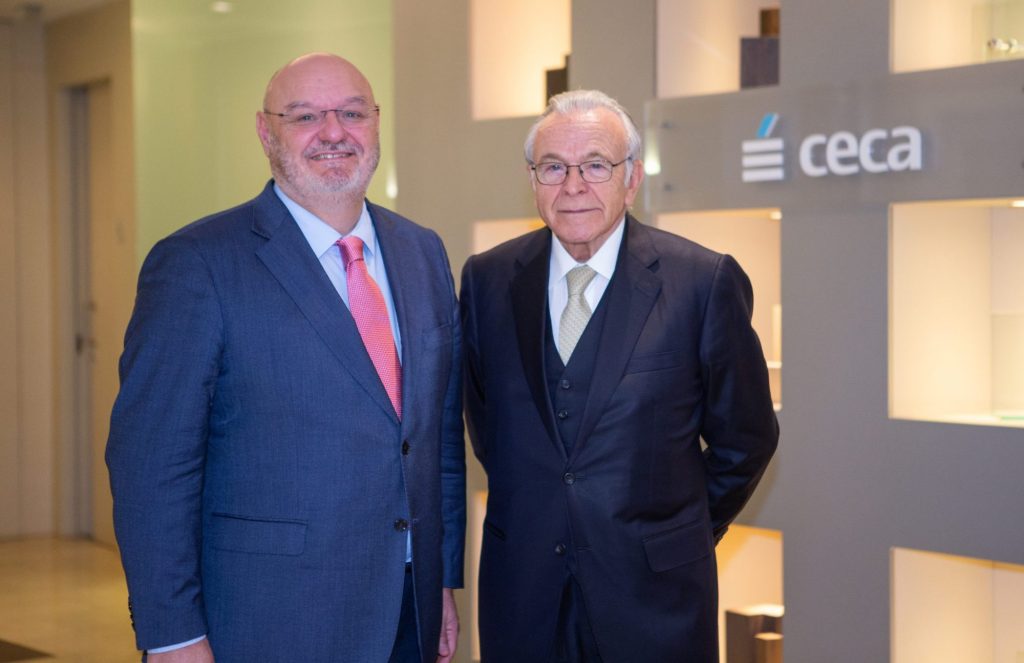
CECA held its 117th General Assembly today, chaired by Isidro Fainé, president of CECA, the “la Caixa” Foundation, and the World Savings and Retail Banking Institute (WSBI), an organization that celebrates a century of history this year.
The event was attended by representatives of the credit entities and foundations affiliated with CECA. The groups of banks and savings banks represented by CECA account for 38% of the Spanish financial system in terms of deposits. In addition, the association groups thirty-two banking and ordinary foundations responsible for designing and implementing Social Action.
During the meeting, Isidro Fainé was unanimously re-elected as president of CECA. The CECA General Assembly also reappointed José Ignacio Goirigolzarri, president of CaixaBank, as vice president of the Board of Directors, Manuel Azuaga, president of Cecabank, as board member, and Josep A. Cifre, president of Colonya Caixa Pollença, as secretary councilor.
The president of CECA, Isidro Fainé, referred in his speech to CECA’s objectives in this new phase: “Our purpose remains unchanged: to contribute to social progress through financing projects that create opportunities for people’s advancement, striving to do everything possible in favor of financial inclusion as a precursor to social inclusion, with a particular sensitivity towards the most vulnerable groups.”
The president also highlighted that “from CECA, we advocate for a model of quality and responsible banking. We will continue to focus on the customer to provide the best possible service and address the main challenges of our time, namely, the transition towards a more sustainable society, with less inequality and thus, more cohesive.”
Regarding the economic situation, Isidro Fainé emphasized “some important challenges that, as a country, all stakeholders must face. On the one hand, reinforcing business investment, using, and if possible extending the impulse from European funds; improving productivity, investing more in human capital, innovation, and entrepreneurship; and finally underpinning the financial stability of the country, for which it is necessary, among other things, that financial entities remain efficient and solvent, and that the public sector ensures budgetary sustainability.”
Fainé also referred in his speech to the support measures for society being developed by CECA and the sector as a whole. In this regard, he highlighted “three unique initiatives: the protocol for elderly persons, aimed at contributing to a more inclusive economy; the rural Spain service protocol, oriented towards tackling the severe problem of depopulation; and finally, the good practices mortgage code, which has in 2023 extended its coverage to all middle classes in the country.”
The CECA sector is consolidating as the largest private social investor in Spain
The Social Action of CECA entities has once again demonstrated its essential role as a lever for social, cultural, and economic progress this year. Associated entities of CECA allocated a total of €851 million to Social Action during 2023, representing an increase of 6.4% compared to the previous year. Thanks to this allocation, over 80,960 activities were carried out, benefiting more than 30 million people, with a special focus on vulnerable groups. Since the approval of Law 26/2013 on Savings Banks and Banking Foundations, the Social Action of the CECA sector has invested more than €7.8 billion and carried out over 930,000 activities. By the end of 2023, there is a recorded increase of 19.9% in investment compared to the 2014 fiscal year, demonstrating the sustainable future of this social model, largely thanks to the reforms driven by the aforementioned law.
The Social Action develops its activity in various areas, aiming to cover all segments of the population, focusing especially on the most vulnerable individuals. As in previous years, the Social Action area has received the largest investment, €312 million (36.7% of the total), allocated to over 16,600 activities related to assistance, health and welfare, inclusion, social dining, and volunteering programs.
The Education and Research area, with an investment of €238 million (28% of the total) and 9.1 million beneficiaries, ranked second. Through this area, the entities promote progress and innovation with training, education, research, and scientific dissemination programs. Additionally, it supports financial inclusion by facilitating access to financial services for all groups, especially the most disadvantaged.
Meanwhile, the Culture and Heritage area received €179 million in 2023 (21.1% of the total), and the Local Development and Job Creation area reached over €78.8 million (9.3% of the total), allocated to support programs for the local business fabric, job promotion, and entrepreneurship, among others.
Finally, the areas of Sport, Leisure, and Environment were jointly allocated more than €42 million (5% of the total). Sport is full of examples of commitment, effort, and overcoming, values shared by Social Action. Furthermore, the CECA sector has a strong commitment to sustainable development, collaborating with various organizations, encouraging the use of sustainable products and services, and conducting activities to conserve natural environments.
Social Action places the 2030 Agenda at the center of its activities, strongly supporting its advancement and implementation and contributing to the Sustainable Development Goals (SDGs). Thus, in 2023, the investment in Social Action from the CECA sector continued to address all 17 SDGs and combined efforts to help reinforce those issues requiring increased attention from Spain, such as health and wellbeing (3), industry, innovation, and infrastructure (9), quality education (4), decent work and economic growth (8), sustainable cities and communities (11), and ending poverty (1).
The Commission for Foundations and Social Action, the main forum for exchanging experiences, cooperation, and study in Social Action matters, also held its annual meeting today. This is a statutory and consultative body of the association that brings together representatives from banking and ordinary foundations in the sector.
Social Action extends internationally
From an international perspective, CECA is taking on an increasingly global role alongside the World Savings and Retail Banking Institute (WSBI). This organization represents the interests of over 6,400 entities from 69 countries managing a combined asset volume of $13.25 trillion, acting as a substantial natural platform for CECA’s international projection.
During the year 2023, WSBI established a Social and Philanthropic Council, whose president is Isidro Fainé. The primary functions of this body are to give visibility to the Social Action activities carried out by its affiliated entities and to promote the exchange of experiences and cooperation to develop joint initiatives on a global level. Currently, entities affiliated with WSBI allocate $2.8 billion annually to Social Action worldwide.
The priorities of the CECA sector in 2024
The director general of CECA, José María Méndez, focused on the current economic-financial situation, addressing the main challenges and priorities of the sector. Associative activity has remained very intense in the European regulatory context throughout 2023, with two dossiers being particularly relevant: Crisis Management and Deposit Insurance (CMDI) and Retail Investment Strategy (RIS). On the national level, the project for a Financial Customer Protection Authority, the Next Generation EU program, and the banking sector’s taxation have stood out.
José María Méndez also addressed the priorities that merit reflection for 2024. On one hand, the digital euro, a key project for the financial industry that CECA is working on to achieve a balanced approach for the stability of the financial system should it ultimately be implemented. Conversely, he highlighted the impact that the transposition of some European directives, such as those on sustainability reporting, Consumer Credit, and Distance Marketing of Financial Products, will have on the sector.
Finally, he assessed the current situation of the Spanish banking sector ten years after the approval of the Law on Savings Banks and Banking Foundations, highlighting “its strength with more capitalized entities, which favor stability and promote the flow of credit to families and SMEs in a context marked by challenges in the Spanish economy such as digital and environmental transformation.”
Others Press Releases
Banking financing capacity would increase by 2 trillion euros with regulatory simplification
Simplifying regulation would increase the banking sector’s financing capacity in Spain by €250 billion