


Fainé: “Our mission is to make good banking for clients and good banking for society”
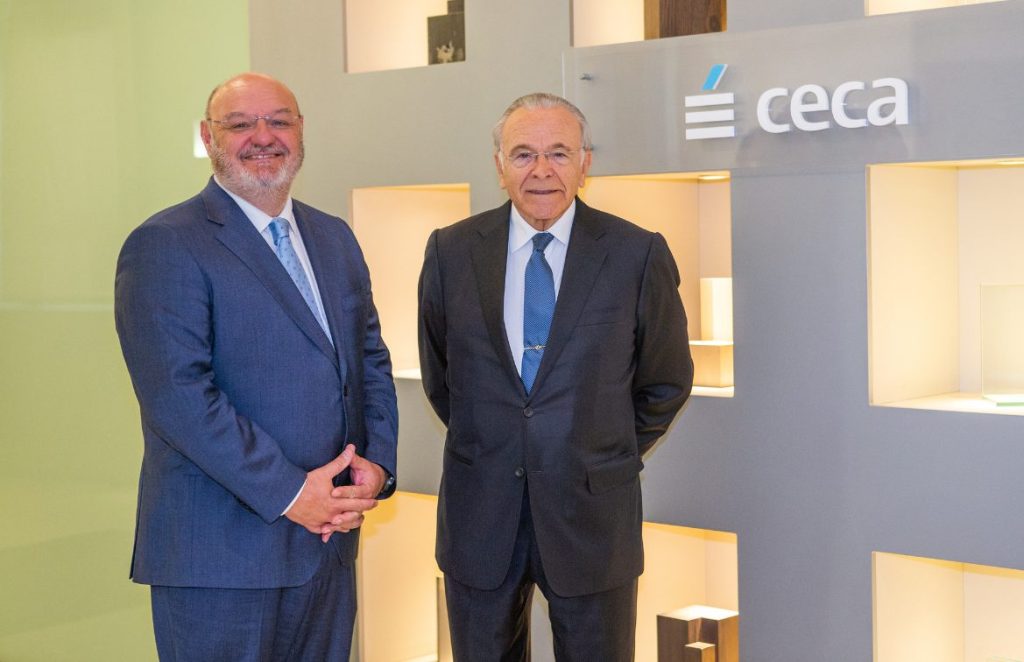
Today the 116th General Assembly of CECA has been held, presided over by Isidro Fainé
The General Assembly of CECA has ratified the incorporation of Antón Arriola Boneta, president of Kutxabank, and Francisco Serrano Gill de Albornoz, president of Ibercaja Banco, as members of the Board of Directors
The CECA sector has allocated over 800 million euros to social initiatives and projects in Spain during 2022, the largest private social investment in the country
The entities associated with CECA, together with other credit institutions in the country, have launched initiatives to improve care for the elderly, among other vulnerable groups
The recent turbulence on both sides of the Atlantic has demonstrated that the Spanish banking sector has a high capacity for resilience and that completing the Banking Union is urgent
CECA held its 116th General Assembly today, presided over by Isidro Fainé, president of CECA and the “la Caixa” Foundation. During the meeting, a review of the sector’s activity in 2022 was made, and future challenges were discussed. The event was attended by representatives of the credit institutions and foundations affiliated with CECA. The eight groups of banks and savings banks represented by CECA account for nearly 40% of the Spanish financial system in terms of deposits. Additionally, the banking association groups thirty-two banking and ordinary foundations that stand out for their philanthropic nature, aimed at promoting local development and with a social purpose.
The president of CECA emphasized the significant effort made by the entities in the sector to provide all necessary resources to help society navigate the current economic situation. In the words of Isidro Fainé, president of CECA: “It is precisely in times of greatest difficulty and uncertainty, like the current one, that CECA and its associated entities have an important mission to continue developing for the benefit of their clients and society as a whole: to make good banking for clients and good banking for society. This is our double challenge.” He added: “Our Social Work is increasingly a pillar of support for many vulnerable people and a driver of educational, scientific, and cultural progress. The Social Work constitutes the soul of our association and we are obliged to protect it. We would like to extend it worldwide.”
The CECA sector, the largest private social investor in Spain in 2022
The Social Work of CECA’s entities has been developing charitable initiatives for over three centuries and has once again demonstrated its essential role as an irreplaceable lever for social, cultural, and economic progress, as well as a complement to public administration programs and the welfare state. The entities associated with CECA allocated 800.16 million euros to Social Work during 2022, which represents an increase of 2.8% compared to the previous year. Thanks to this funding, over 72,000 activities have been carried out, benefiting more than 32 million people, especially vulnerable groups. Since the approval of Law 26/2013 on Savings Banks and Banking Foundations, the Social Work of the CECA sector has invested nearly 7 billion euros and has carried out over 849,000 activities, representing a 12.71% increase since 2014.
The Social Work develops its activity in various areas, aiming to cover all segments of the population, with a particular focus on vulnerable groups.
As in previous years, the Social Action area has been the area receiving the most investment, 313 million euros (39% of the total), allocated to over 20,500 activities around assistance programs, health and well-being, inclusion, social dining, and volunteering. Activities have also been carried out aimed at vulnerable groups to improve their integration into society.
The Education and Research area, with an investment of 219 million euros (27% of the total) and 12.4 million beneficiaries, ranked second. Through this area, the entities promote progress and innovation with training, education, research, and scientific dissemination programs, as well as supporting financial inclusion by providing comprehensive services and facilitating access to financial services for all groups, especially the most disadvantaged.
Furthermore, the Culture and Heritage area had a budget of 153 million euros (19% of the total) in 2022, and the Local Development and Job Creation area reached nearly 81 million euros (10% of the total), allocated to local development programs, support for business fabric, job creation, and entrepreneurship, among others.
Finally, over 34 million euros (4% of the total) were jointly allocated to Sports, Leisure, and Environment. Sports are full of examples of dedication, effort, and overcoming, values shared by the Social Work that has been applied to its projects for over 300 years. Additionally, the CECA sector has a strong commitment to sustainable development, collaborating with different organizations, promoting the use of sustainable products and services, and carrying out activities for the conservation of natural environments.
The Social Work places the 2030 Agenda at the center of its activity, firmly supporting its progress and implementation, and contributing to the Sustainable Development Goals (SDGs). Thus, in 2022, the investment in Social Work from the CECA sector has continued to address the 17 SDGs and has combined efforts to help strengthen those whose issues required greater attention from Spain, such as poverty, health and well-being, decent work and economic growth, industry, innovation and infrastructure, reduction of inequality, or zero hunger, among others.
The Commission of Foundations and Social Work, the main forum for exchanging experiences, cooperation, and study in Social Work, has also held its annual meeting today. This is a statutory and consultative body of the association that brings together representatives of banking and ordinary foundations in the sector. The opening event featured Clara Arpa, president of the Spanish Network of the Global Compact.
Ensuring the elderly feel well cared for, one of the great challenges of banking
In his speech, Isidro Fainé highlighted three initiatives undertaken in 2022 that emphasize the sense of social responsibility in our way of banking: the Roadmap to strengthen financial inclusion in rural areas to alleviate the problem of depopulation in various territories of Spain; the measures for mortgage relief to respond to the needs of the most vulnerable clients amid the rapid rise in interest rates; and the Protocol for improving care for the elderly, ensuring that the sector’s digitalization does not leave any group unattended.
In 2021, industry associations presented the Strategic Protocol to reinforce social and sustainable commitment in banking with measures aimed at strengthening care for vulnerable clients, including the elderly. In 2022, the entities acquired new commitments in this area, and in March of this year, they reported, for the second time, the progress made in implementing the agreed measures.
In this regard, it is important to note that banking users have expressed some concern about the possibility that savings accounts were being closed by some entities. For this reason, the entities confirmed through their associations the commitment to ensure that all clients over 65 years old who hold an account can maintain it. The CECA sector encompasses 8.6 million savings accounts.
Another area where CECA’s actions generate significant social benefits is Financial Education. Isidro Fainé recalled that “we have renewed our commitment to the National Financial Education Plan alongside the Bank of Spain, the CNMV, the Ministry of Economic Affairs and Digital Transformation, and other public bodies” and announced a new allocation to the Financial Education Stimulus Program (Funcas Educa).
The Spanish banking sector, resilient with notable solvency and liquidity
Another topic raised by the General Director of CECA, José María Méndez, was the uncertainty caused a few weeks ago by several banks on both sides of the Atlantic. In light of this situation, the Spanish banking sector has demonstrated a high capacity for resilience, facing these instability scenarios and the most recent tensions in the markets with solid capital and liquidity positions. In fact, the solvency of Spanish entities remains at levels higher than those reached in December 2019, prior to the crisis caused by COVID-19.
José María Méndez posed important questions for reflection to the attendees. On one hand, there is a need to extend the Basel Committee standards to a highly globalized financial sector. These standards, which have shaped the regulatory orthodoxy in prudential matters for decades, are designed for internationally active banks. However, in many jurisdictions (including the EU), their rules extend to all credit institutions, regardless of their size. In the U.S., on the contrary, Basel’s prudential requirements, including liquidity requirements, apply only to the large ones.
Finally, the need to unify efforts to complete the Banking Union resurfaces. In one of the recent meetings of EU leaders, there was a call to strengthen the crisis management framework and the use of national deposit guarantee funds. Indeed, a decade after its foundations were laid, the Banking Union project is still not a full reality. While the two initial pillars (SSM and SRM) are operational, the goal of having a common deposit guarantee scheme still appears distant. In this sense, the Spanish Presidency of the EU, which will take place in the second half of 2023, may be an excellent opportunity to relaunch this debate.
The General Director of CECA, José María Méndez, concluded his remarks at the Assembly by stating that “the recent banking turbulence on both sides of the Atlantic has demonstrated three things: first, the need to extend the Basel Committee standards to a highly globalized financial sector; second, the increasing crisis of credibility of the resolution framework; and finally, the urgency of completing the Banking Union.”