


The contribution of the CECA Sector to the Spanish economy increased by 32% in 2020 to reach 233,905 million euros
The financing granted once again stands out as the item with the most impact on the economy, surpassing 212,500 million euros
The entities of CECA (CaixaBank, Kutxabank, Cajasur Banco, Abanca, Unicaja Banco, Ibercaja Banco, Caixa Ontinyent, Colonya Pollença, and Cecabank) reaffirm their commitment to socially responsible investment once again
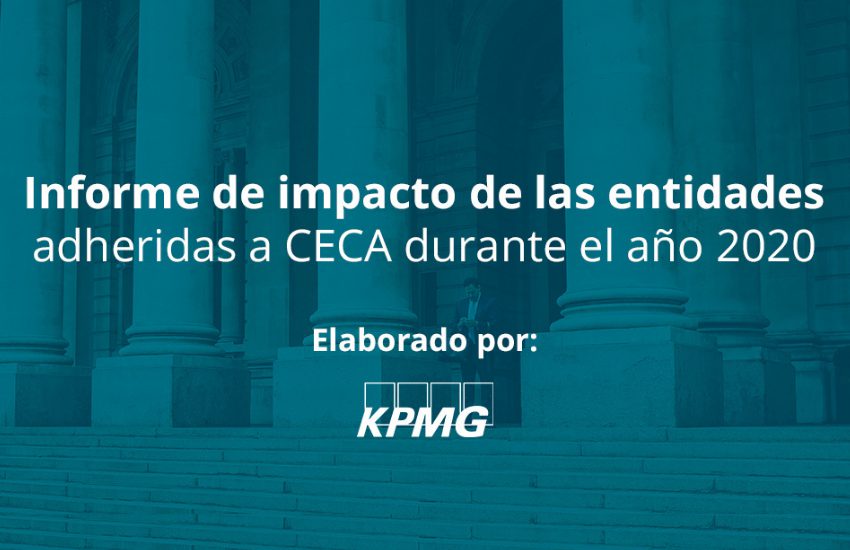
The total impact of the entities adhering to CECA on the economy in 2020 was 233,905 million euros. This figure represents a 32% increase compared to the amount reached in 2019. The data is collected in the ‘Impact Report of the entities adhering to CECA during the year 2020’, prepared by KPMG for the third consecutive year. The study, which was presented today by Jerusalem Hernández, partner of Sustainability and Good Governance at KPMG, highlights that this contribution is equivalent to 19% of Spain’s GDP, an increase of 5 percentage points compared to the previous year.
The reflected impact results from their corporate activity, which includes salary payments and purchases from suppliers; the dynamism derived from the financing granted by these entities to families and businesses; and also from their social contribution through social action projects, environmental protection, or innovation.
Financing as an impetus for economic activity
The dynamization of the economy through the financing granted is once again the activity generating the greatest impact, surpassing 212,500 million euros, which is equivalent to 17% of Spain’s GDP. 56.1% of this amount, that is, 119,152 million euros, corresponds to the direct financing granted.
The indirect impact, which relates to the incidence of the financing of associated entities, is 22.2%, or 47,110 million euros. This amount corresponds to the activity generated in the first and second levels of the supply chain of the financing recipients. Finally, the impact from induced activity, which refers to the rest of the supply chain, amounts to 46,244 million euros, representing 21.7% of the financing granted.
Overall, according to the document prepared by KPMG, the impact of the financing granted supports 845,838 companies. In this regard, the report notes that during the most challenging moments of the pandemic, 33,108 million euros were mobilized in ICO lines.
As for corporate activity, which includes salary payments and purchases from suppliers, the impact during the period was 21,398 million euros, in line with the previous year, which represents 46.5% of the financial sector’s GDP. The development of this activity has generated a real impact on the Spanish economy by stimulating household consumption through net wages and salaries (7,642 million euros) and boosting national suppliers (7,209 million euros). These figures show an increase of 2.2% and 7.8% respectively compared to the 2019 fiscal year. The rest of the amount associated with this chapter is due to Gross Operating Surplus, that is, the difference between the production value and intermediate consumptions.
By sectors, corporate activity has a significant driving effect within the financial sector itself, where a dynamization of over 2,300 million euros is estimated. Secondly, the industry records an impact of 2,143 million euros, equivalent to 17.2% of the gross added value of the motor vehicle manufacturing industry. Construction and real estate are in third place with an estimated impact of 1,978.5 million euros. Thus, these sectors account for 43% of the impact generated by the corporate activities of the entities.
Focus on the client and sustainable financing
In 2020, nearly 82,100 million euros were allocated to financing for household consumption, SMEs, and self-employed individuals. This figure represents an increase of over 6,300 million compared to the 2019 fiscal year. On one hand, 55,207 million euros were allocated to SMEs and self-employed individuals, representing 41.5% of the total national financing from these entities. On the other hand, household consumption financing amounts to 26,876 million euros, while mortgage loans and home renovation loans total approximately 17,730 million euros.
The document presented today also reflects that the CECA Sector follows the market trend regarding responsible investments, as the adhering entities have mobilized 69% of the issuance of green, social, and sustainable bonds in Spain. Thus, in 2020, the volume of emissions of such products mobilized by the adhering entities reached 10,400 million euros, including issuances and actions as placement agents. These bonds have been primarily allocated to financing renewable energy projects and energy efficiency, as well as to addressing the social repercussions of COVID-19. Only the mobilization allocated to renewable energies has exceeded 6,093 million euros through Project Finance programs across 108 operations.
On the other hand, socially responsible investment has also increased. Thus, the total volume of assets in Sustainable and Responsible Investment (SRI) in 2020 managed by the entities of the CECA Sector with ESG criteria was 180,595 million euros. This represents an increase of 12.5% compared to 2019 and 79% of the SRI in national assets.
Post-pandemic economic context and its importance for the financial sector
For his part, Santiago Carbó, director of the Financial and Digitalization Area of Funcas, explained that the economic context remains challenging and poses challenges for governments, central banks, and financial and non-financial companies.
In his words, “The generalization of bottlenecks, particularly acute in advanced economies, and the rising energy costs undermine global recovery while intensifying inflationary pressures.” He also added that “a decoupling of monetary policies is observed and no increases in interest rates are expected in the eurozone (yes in the United States and which have already occurred in the United Kingdom) before 2023, so European banks will have to continue dealing with very narrow interest margins.