


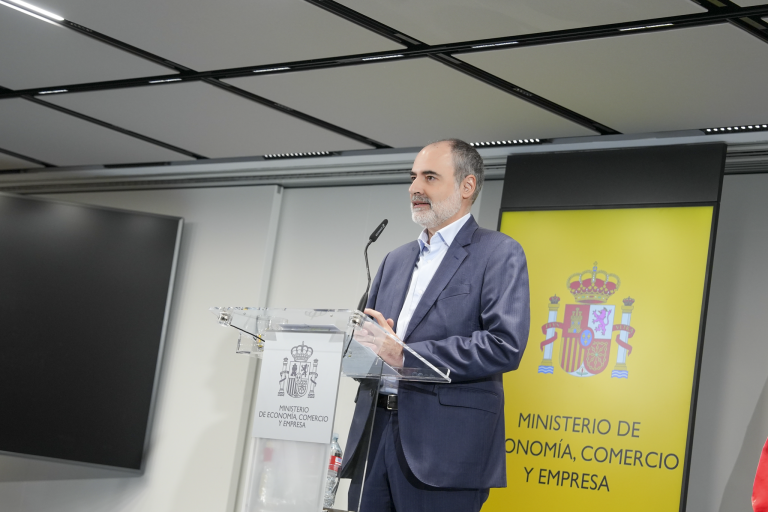
The banking sector engages with various social actors on sustainability, digitalization, and financial education
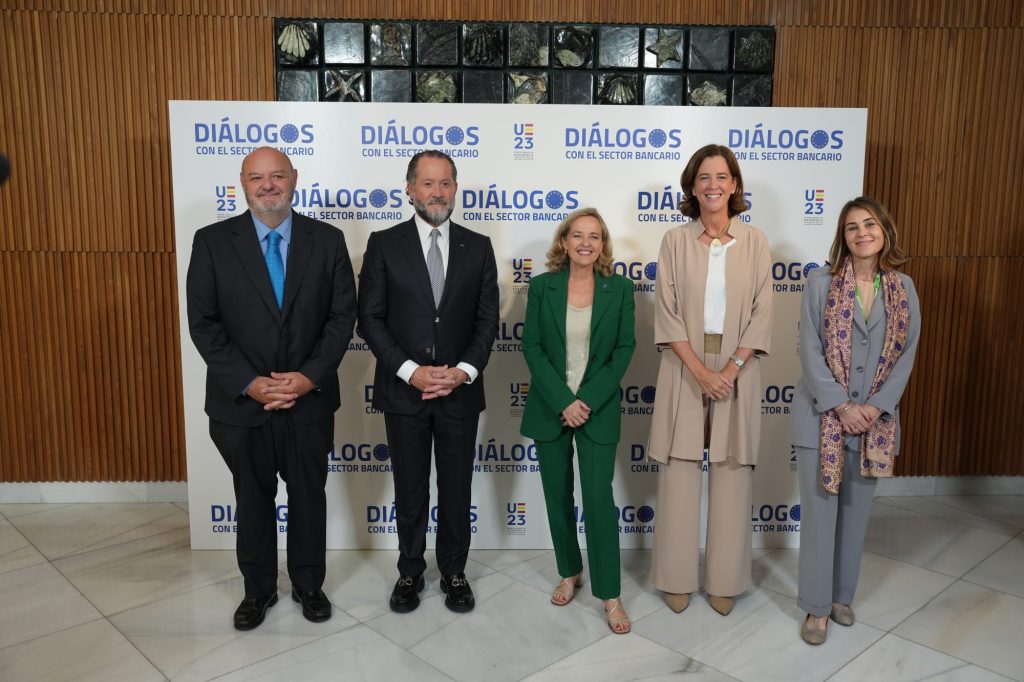
The event ‘Dialogues with the banking sector for economic and social progress’ was held under the Spanish Presidency of the Council of the European Union, coinciding with the first meeting of Economic and Finance Ministers of the European Union and Latin America
The banking associations AEB, CECA, and Unacc, in collaboration with the Spanish Presidency of the Council of the European Union and with the support of Abanca, organized the event “Dialogues with the banking sector for economic and social progress” as part of the international meetings with Latin America held in Santiago de Compostela.
The event took place at the Sociocultural Center of Abanca in the same city and was inaugurated by the president of Abanca, Juan Carlos Escotet. It served as a reflection on the present and future challenges facing the banking sector in relation to sustainability, digitalization, and financial education, which were the central themes of the discussions.
Senior officials from the Ministry of Economic Affairs and Digital Transformation, the Treasury, the Bank of Spain, the Xunta de Galicia, and Latin American institutions participated in the event. Additionally, representatives from the employers’ associations AEB, CECA, Unacc, and their associated entities were present.
In the inauguration, the president of the Xunta de Galicia, Alfonso Rueda, highlighted the opportunity that events like this present in Santiago, under the Spanish Presidency of the EU Council, for promoting Galicia internationally.
He also stated the necessity of engaging companies and banks to advance economic progress, which in turn leads to social advancements. In the panel “Banks as a lever for economic growth: domestic and international”, CECA’s Director General, José María Méndez, elaborated on the banking sector’s contributions towards addressing regulatory challenges during the Spanish Presidency and emphasized that “banking generates a quadruple impact: financial and social inclusion, thanks to its reach, tax payments, job creation, and the stimulation of a sustainable economy.”
Subsequently, the sector initiated discussions on the present and future challenges regarding sustainability, digitalization, innovation, and social commitment and financial education. In this regard, the General Secretary of UNACC, Cristina Freijanes, addressed the challenge of social commitment within the sector, how it will evolve in the future and noted that, in any case, “it must consider the financial inclusion of all segments of society in the face of unstoppable digitalization.” She believes that the banking sector will be able to tackle the challenges it faces because, “if we have demonstrated anything, it is that we are capable of adapting in a timely manner.”
The final panel was moderated by the president of AEB, Alejandra Kindelán, who emphasized the role of banks as facilitators of savings to investment and how in that process “we accompany families, companies, and countries.” Addressing the challenges presented, Kindelán explained that “our sector will continue to deploy its capacity for investment, financing, and growth to promote economic and social development, both in the European Union and in Latin America.”
The First Deputy Prime Minister and Minister of Economic Affairs and Digital Transformation in office, Nadia Calviño, concluded the day by defending public-private collaboration on the path towards the green and digital transition, indicating that the future of a better society depends on all economic and social actors, including banking. “These meetings are a success and send a message of commitment to dialogue, multilateralism, and European and international institutions, to respond in a coordinated and supportive manner to the challenges we face.”
The event brought together high representatives from major economic institutions and relevant banking entities in Santiago de Compostela, fostering extensive dialogue and contributing to strengthening the banking sector’s commitment to the challenges facing the country, with a broad social perspective, particularly regarding the green and digital transition, as well as various open regulatory files.
Others Press Releases
Banking financing capacity would increase by 2 trillion euros with regulatory simplification
Simplifying regulation would increase the banking sector’s financing capacity in Spain by €250 billion