


Why is the savings rate of Spaniards at historic lows?

CECA organizes the IX Conference on Financial Education, which this year takes place within World Savings Day.
During the event, the virtual exhibition was inaugurated: “Learning to Save: The Teaching of Saving, Source of Financial Education”.
Since the peak in 2009, the savings rate of Spanish households has experienced a decline to historic lows, with two distinct phases: the crisis and the current recovery. During the recession, rising unemployment and lower disposable income led to a deterioration in the savings capacity of Spanish families. But why has savings continued to fall during the recovery? This is one of the issues addressed today at the IX Conference on Financial Education organized by CECA, coinciding with World Savings Day.
According to the explanation given by the senior economist from Funcas, Mª Jesús Fernández, three factors explain the continued decline of the savings rate, down to the minimum of 4.4% in the second quarter of 2018. First, the growth in employment and improvement in living conditions have encouraged families to consume and exhaust the pent-up demand during the crisis. Second, low-interest rates provide no incentive to save. And finally, the wealth effect resulting from the revaluation of assets like housing. “If savings continue to decrease and home purchases keep increasing, the process of debt reduction for families over recent years could come to an end,” the Funcas expert pointed out.
Commitment to financial education and savings
Alongside its commitment to disseminating financial education in Spain, CECA has a long history tied to saving and social commitment, which remains a priority for its members. In this regard, the virtual exhibition was also presented today: “Learning to Save: The Teaching of Saving, Source of Financial Education”. At the link www.ceca.es/diadelahorro2018, it is now possible to visit from any device the evolution of the teaching of saving to what we now know as financial education.
CECA, which also celebrates its 90th anniversary this year as a member of WSBI ESBG, has developed numerous initiatives to promote financial education among young people and adults. The search for innovative methods and constant updating of content are key to the activities developed.
An example of this is the website created by WSBI-ESBG on the occasion of this Day, where various events will be listed that will take place in participating countries for World Savings Day 2018.
The IX Conference on Financial Education was inaugurated by Mr. José María Méndez Álvarez-Cedrón, General Director of CECA, and included the participation of Mr. Fernando Tejada de la Fuente, Director of Market Conduct and Complaints at the Bank of Spain, and Ms. Gloria Caballero Núñez, Deputy Director of Financial Education, within the Department of Strategy and Institutional Relations of the National Securities Market Commission (CNMV). They are responsible for the Financial Education Plan 2018-2021, to which CECA is affiliated as a collaborator, as well as its associated entities.
Nine entities join the Funcas-Educa Program
Mr. Carlos Ocaña Pérez de Tudela, General Director of Funcas, and Ms. Mónica Malo, Director of Communication and Institutional Relations at CECA, presented the status of the Funcas Financial Education Stimulus Program, to which a total of nine entities have joined throughout 2018. Abanca, Bankia, Caixabank, Caixa Ontinyent, Caixa Pollença, Grupo Ibercaja, Grupo Unicaja, Kutxabank, and Liberbank have detailed the scope of their projects, highlighting the extensive reach in disseminating financial education throughout the territory and the main beneficiaries of the programs: youth, adults, seniors, entrepreneurs, and profiles at risk of exclusion.
The so-called Funcas-Educa Program, endowed with three million euros, is an initiative designed to contribute to funding financial education activities carried out by the entities affiliated with CECA, either directly or through their linked foundations.
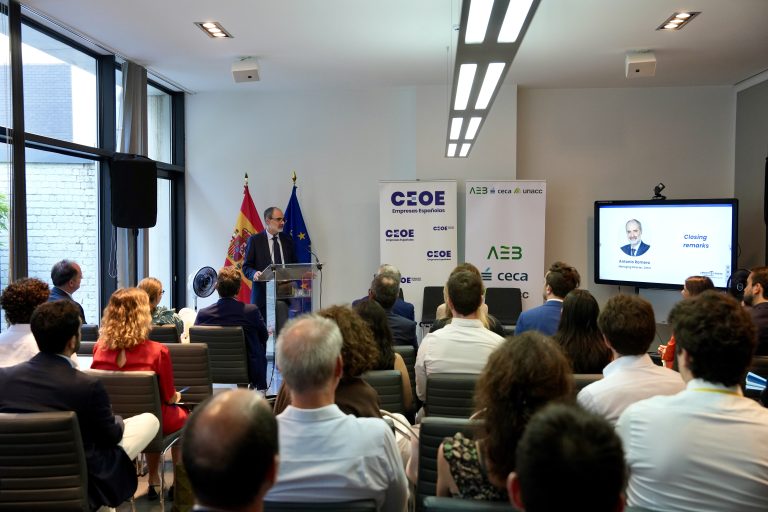
Among its innovations, a microsite has been presented with specific information about the entities and their projects that make up the program, to enhance visibility and reach all segments of the population. This space has been integrated into both the FUNCAS website (http://www.funcas.es/) and the platform of the Spanish Network of Financial Education (http://www.rededucacionfinanciera.es/) and is accessible from today. To close the day, Mr. Antonio Romero Mora, Corporate Director of Associative Services, Control, and Resources at CECA, emphasized that “for CECA and its affiliated entities, financial education is an absolute priority that we have been working on for many years, as reflected throughout the day, but being aware that we must continue to work and open up new lines of work that help society make financial decisions as objectively and accurately as possible for their interests.”
An active participation with a long trajectory
Since 2008, with the launch of the First Financial Education Plan (2008-2012) promoted by the Bank of Spain and the CNMV, CECA joined as a collaborator, renewing for the period 2013-2017 and recently for the current Plan 2018-2021.
In 2008, CECA, along with its affiliates, created a working group that has allowed for the exchange of experiences and best practices and the promotion of action plans in this area over the past few years.
The Financial Education Network aims to be a meeting point for financial education professionals and is supported by the website www.rededucacionfinanciera.es. This portal, updated daily, is a platform that houses information about courses, workshops, conferences, learning materials, and resources, as well as links to active national and international agents.
CECA and its affiliates actively collaborate on Financial Education Day with activities throughout the national territory, demonstrating support and commitment to the promoters of the Plan.