


The CECA Sector Presents Its Priorities to the Spanish Presidency of the Council of the European Union
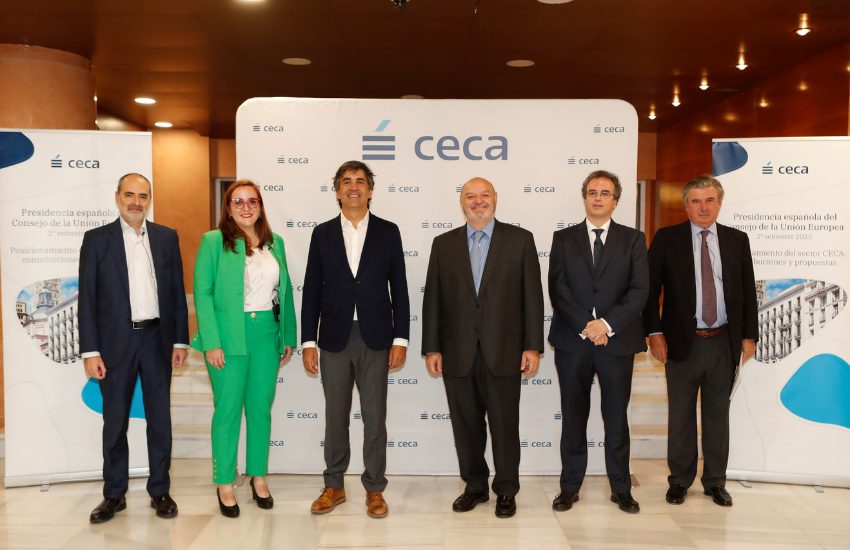
As part of the upcoming Spanish Presidency of the Council of the European Union, CECA presents the document Positioning of the CECA Sector: Contributions and Proposals
The document was made public at an event attended by the Secretary of State for Economy and Business Support, Gonzalo García Andrés, and prominent representatives from the banking sector
CECA establishes itself as a key interlocutor for the Spanish financial sector before regulatory and supervisory institutions, both nationally and internationally
On July 1, and until December 31, Spain will assume the Presidency of the Council of the European Union. In this context, the CECA sector, which includes CaixaBank, Kutxabank and Cajasur Banco, Abanca, Unicaja Banco, Ibercaja Banco, Caixa Ontinyent, Colonya Pollença, and Cecabank, aims to contribute to shaping the priorities of the economic and financial agenda that will guide the activities of the Spanish presidency during this period.
To this end, the document Positioning of the CECA Sector: Contributions and Proposals has been prepared and presented today at an event held at CECA’s headquarters, where various perspectives were shared in a bid to advance on key issues in the current European regulatory agenda.
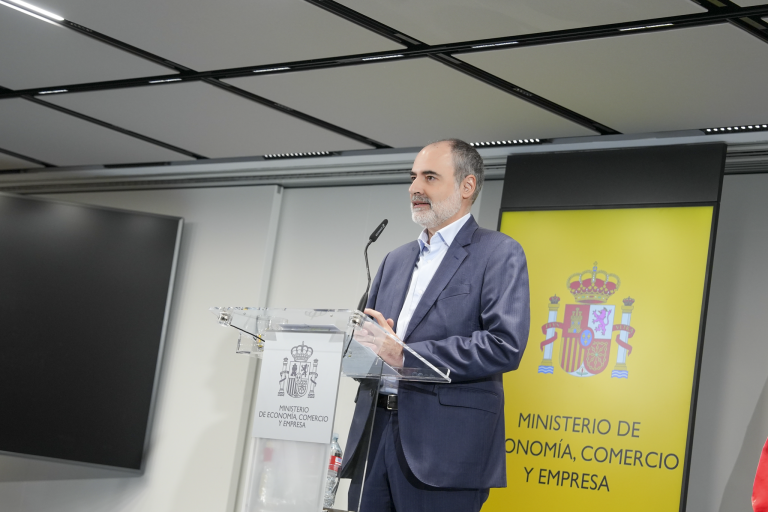
At the opening of the event, Gonzalo García Andrés, Secretary of State for Economy and Business Support, and José María Méndez, General Director of CECA, engaged in a dialogue about the evolution and future of financial regulation.
In his speech, Gonzalo García Andrés emphasized: “The goal of the presidency is to solidify the position of the European Union in the current complex geopolitical context through the acceleration of the energy transition and advancing integration, especially in economic and financial aspects.” Regarding the aspects that specifically affect the banking sector, he continued: “We are going to push for the Capital Markets Union and also try to make progress on Banking Union.”
Likewise, concerning the challenge of sustainability, the Secretary of State highlighted that “the Spanish financial sector has been at the forefront of modernizing the economy over the past 50 years.” In this regard, the General Director of CECA presented “the role that the Center for Sustainable and Responsible Finance in Spain, FINRESP, which brings together AEB, CECA, INVERCO, UNESPA, and UNACC, can play in valuing the efforts being made by the financial sector in channeling capital flows towards a decarbonized and more sustainable productive fabric.”
Subsequently, the presentation of the document Positioning of the CECA Sector: Contributions and Proposals, was conducted by Luis Teijeiro, Director of Regulation and Studies of CECA.
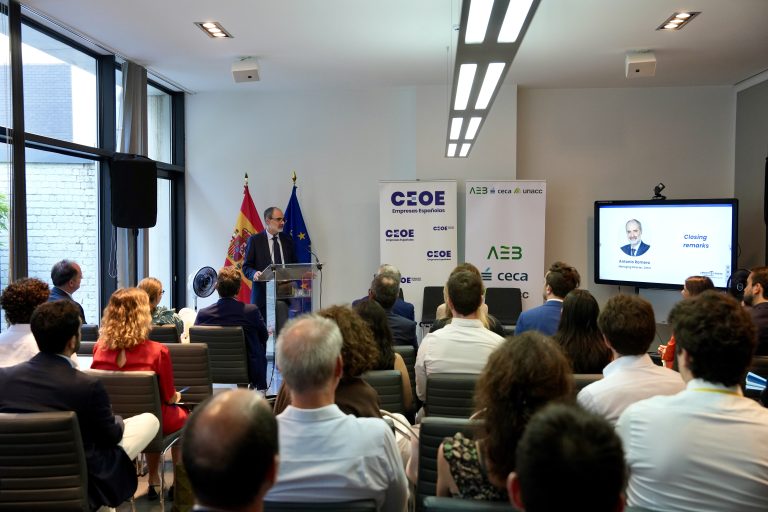
To conclude the event, a sectorial colloquium titled “The Financial Sector Facing the Spanish Presidency of the EU Council” took place, featuring prominent representatives from the banking sector. Francisco Serrano, President of Ibercaja Banco, Carlos Bastarreche, former ambassador of Spain to the EU and advisor to CECA on European matters, and Judith Arnal, Professor of the Master’s in Banking and Financial Regulation at the University of Navarra, counselor at the Bank of Spain, and Senior Research Fellow at the Real Instituto Elcano, participated. The moderation was handled by Antonio Romero, Corporate Director of Associative Services and Resources at CECA.
Positioning of the CECA Sector: Contributions and Proposals
In preparing the document, the Strategic Agenda 2019-2024, adopted by the European Council on June 20, 2019, and the European Union’s response to the health and economic crisis triggered by the pandemic outbreak in March 2020 and the onset of the Ukraine war have been taken as a basis to drive the necessary measures that will energize economic activity.
The document identifies, categorized by topics, the financial regulation files that, due to their relevance and impact on the economy and society, we consider should be addressed as a priority during the Spanish presidency. For each of them, the position of the CECA sector is recorded, identifying the key elements from the viewpoint of financial entities. The priorities are selected based on a dual objective: to identify the regulatory files with the greatest impact on economic and financial activity; and to make the sector’s position known, in order to contribute to the political debate surrounding them.
The analyzed topics encompass diverse subjects: solvency, sustainability, financial markets, anti-money laundering and counter-terrorism financing, payments and digitalization, Banking Union, and Next Generation EU funds. Thus, in terms of solvency, the CECA sector advocates for the implementation of proportional and balanced prudential regulation, with special attention to the banking package of 2021; in the realm of sustainability, we seek to strengthen the role of credit institutions in the sustainable transition, focusing on due diligence in the supply chain regarding environmental matters and human rights, and on the EU’s green agenda; concerning markets and AML/CFT, our sector supports initiatives that protect the integrity of financial markets, among the most relevant topics being the AML/CFT package and incentives in investment products; in terms of payments and digitalization, we wish to contribute to the digital transformation of payment methods focused on the Open Finance & Payment Services Directive (PSD3) and digital euro; regarding Banking Union, CECA supports its construction as a fundamental pillar of the European Union project; and regarding the Next Generation EU funds, we consider them crucial for transforming and enhancing public-private collaboration.
Connecting the World Through Banking
One of the pillars of CECA’s activity is the representation and defense of the interests of its associated entities in multiple cooperation forums at national and international levels to energize cross-sector dialogues and collaborate especially with organizations and authorities. Thus, CECA constitutes a cardinal piece of the Spanish financial sector and a key collaborative agent of fundamental institutions for society at local, national, and international levels.
From a global perspective, the importance of the World Savings and Retail Banking Institute (WSBI) at the international level stands out, as do the strong ties it maintains with CECA, given that both institutions share common values, as evidenced by both being presided over by Isidro Fainé. This institution gathers over 85 members, representing 67 countries, accumulating more than 1.4 billion customers and over 13 trillion euros in assets. WSBI firmly supports inclusive, fair, and equitable globalization, thus backing international efforts to enhance access to inclusive finance.
CECA is a member of the Institute of International Finance (IIF), through which it participates in regulatory and normative initiatives. Furthermore, it is particularly active in the annual meetings of the International Monetary Fund and the World Bank, and is a notable member of the Financial Action Task Force (FATF), whose primary function is to develop policies that help combat money laundering and the financing of terrorism.
CECA’s involvement in organizations like these facilitates its presence in high-caliber international negotiations.
In this era of profound transformations, the Spanish Presidency of the Council of the European Union takes on maximum relevance. Therefore, institutions and companies need to reinforce their public-private collaboration with the aim of uniting efforts in the search for more flexible and resilient systems.