


The banking sector recognizes progress in its social commitment
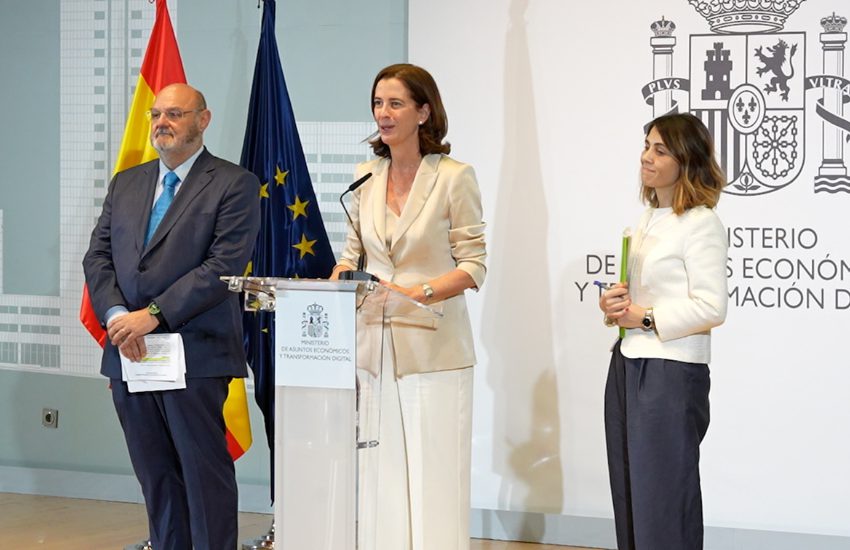
AEB, CECA, and Unacc presented today at the Ministry of Economic Affairs and Digital Transformation the advancements in their commitment to supporting society
They highlight improvements in personalized attention for the elderly, with more than 6.3 million direct beneficiaries and 245,000 participants in training initiatives, and the expansion of financial inclusion in rural areas, with over 400 municipalities granted access to financial services
AEB, CECA, and Unacc held a meeting today at the Ministry of Economic Affairs and Digital Transformation to follow up on the various protocols that have been developed over the past year and a half. All pursue a common objective and reflect a clear vocation of the sector: to reinforce the social and sustainable commitment of banking to help address the challenges we face as a society, such as the impact of digitalization, depopulation, or the effects of rising interest rates.
Among those attending the meeting was the Vice President and Minister of Economic Affairs and Digital Transformation, Nadia Calviño; the Governor and Deputy Governor of the Bank of Spain, Pablo Hernández de Cos and Margarita Delgado, respectively; as well as associations of consumers and the elderly.
Banking associations detailed the efforts made in rural areas according to the annual follow-up report: access to banking services has been established in 433 municipalities, benefiting 162,641 people who now have a physical access point in their municipality. Consequently, the population residing in a municipality without access point in Spain decreased from 1.4% in 2021 to 1% in 2022.
In the 243 municipalities with more than 500 inhabitants identified at the beginning without access to cash, based on data up to March, 139 have a solution planned, either implemented or in process. This represents a 57% reduction in municipalities, benefiting 124,000 people from the measures taken.
Additionally, the sector is making progress on the technical work for creating a white-label ATM for rural Spain, if necessary, to complement the rest of the measures already implemented. This innovative measure is a product of the joint effort of entities and their commitment to offering financial services throughout the country.
On another note, the annual follow-up report on personalized attention for the elderly reflects the outcome of concrete measures applied by the banking sector:
-6.3 million people over 65 have benefited from extended banking hours, from 9 a.m. to 2 p.m., representing 81% of all branches.
-2.4 million calls have been attended to by a personal manager.
-70,000 bank employees have received specific training to provide more tailored attention to the elderly.
-91% of ATMs and over 80% of websites have adapted with simplified views and menus.
In this area, other initiatives have been undertaken, such as a satisfaction survey where over 70% of the elderly expressed satisfaction with the banking attention received through various channels. The dissemination of measures aimed at the elderly has also been reinforced with the distribution of informative brochures in bank branches and digital channels.
The banking sector has also reaffirmed its commitment to financial education and digital skills training, with new initiatives. The goal is to facilitate access to knowledge and skills that help all individuals make financial decisions with a higher degree of information, operate across all available environments and channels, and securely access public and private services.
Additionally, the associations have emphasized the Code of Good Practices agreed upon in 2022 to alleviate the mortgage burden on vulnerable families or those at risk of vulnerability due to the rise in official interest rates, defending its preventive character.