

Representatives of Retail Banks Meet in Seville to Discuss the Challenges of Banking Regulation and Financial Digitalization
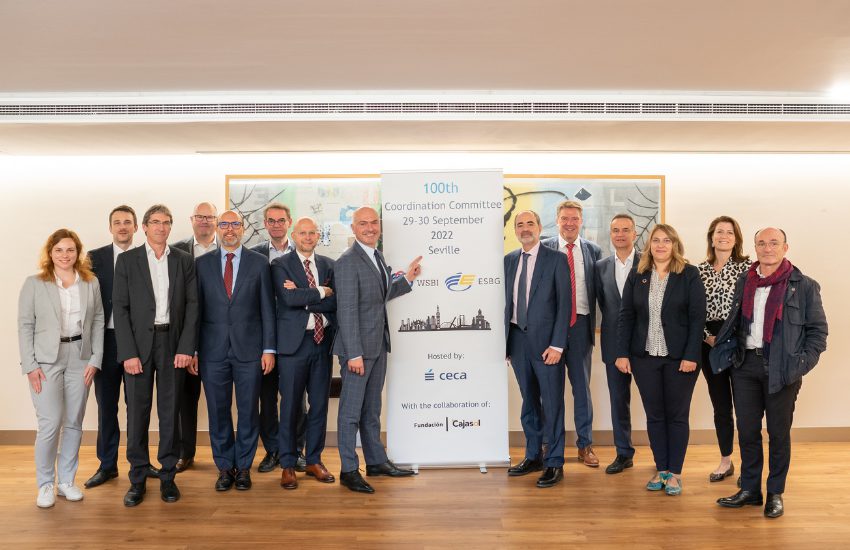
Delegates from various countries gathered at the 100th Coordination Committee of WSBI-ESBG to discuss the Basel IV agreement, the Banking Union project, and sustainable finance, among other topics.
Martin Moloney, Secretary General of IOSCO, participated in the meeting.
CECA is an active member of international associations -World Savings and Retail Banking Institute (WSBI) and European Savings Banks Group (ESBG)- that represent the retail banking model prioritizing financing for families and SMEs, a model with which the entities affiliated with CECA fully identify.
Representatives from both associations met yesterday and today at the 100th Coordination Committee, held at the Foundation Cajasol in Seville to discuss the new challenges facing the sector in terms of international banking regulation.
Participants analyzed the regulatory environment from different perspectives, such as the Basel IV agreement, the Banking Union project, and sustainable finance, among others. New technologies drive financial innovation, which is progressing on various fronts in the payment world; thus, the meeting addressed current trends such as the future digital euro, the new MiCA regulation, and the latest developments in instant payments and digital identity.
The Coordination Committee, serving as a meeting point to coordinate the associative activities of the European Group and the World Institute, is composed of directors from the affiliated entities and meets at least three times a year. Antonio Romero, Corporate Director of Associative Services and Resources of CECA, presides over this statutory body that supervises and advises both organizations with the aim of guiding and formulating proposals related to the work program and priorities to be decided by the Board of Directors and the Committee of Presidents.
The event, which included delegates from various countries, took place over two consecutive days and featured Martin Moloney, Secretary General of IOSCO (International Organization of Securities Commissions), as a guest speaker.
Martin Moloney emphasized in his speech the changing nature of competition in financial services and the importance of agility on the part of policymakers to keep pace with technological innovation and the need to build a sustainable global financial market.
Representatives from the joint office of WSBI-ESBG also attended, highlighting the presence of Peter Simon, Director General of the World Institute and the European Group, and Anna König, Advisor to the General Directorate of WSBG. From ESBG, Diederik Bruggink, Head of Payments and Innovation, and Dominique Carriou, Head of Regulatory Affairs, were present.
Coordination Committee, Core of WSBI-ESBG on Banking Regulation
During the meeting, the working group defined the common strategy regarding the finalization of Basel III and reflected on other relevant topics for the financial sector that are on the regulatory agenda, as well as on financial stability: non-performing loans (NPLs) and prudent treatment of crypto-assets and climate risk. The shift towards a more sustainable economic model, as well as the challenges and opportunities of sustainable finance, were also analyzed.
Antonio Romero, President of the Coordination Committee and Corporate Director of Associative Services and Resources of CECA, highlighted the importance of continuing to collaborate internationally among the different members of the organization to exchange best practices that help address global challenges, promote the harmonization of regulatory requirements, and give visibility to their social contribution.
Regarding innovation and payments, the Coordination Committee discussed the digital euro, focusing on the collaboration project between the European Central Bank (ECB) and the five selected companies to develop user interfaces for specific use cases with this digital payment method. Additionally, representatives from different countries debated the latest developments in European regulation for electronic payment services, such as the SEPA Access to Payment Account Scheme (SPAA), which will establish the procedures, rules, and standards that will enable the sharing of information related to payment accounts and initiation of payment services within the context of basic services under PSD2.
Moreover, it was announced that the ESBG conference “My World, My Knowledge, My Future: A Female Approach to Financial Education” will take place on October 27. This forum will analyze the current state of financial literacy from a gender perspective, aiming to improve financial education for women so they can acquire the necessary financial knowledge and skills for effective personal financial management.
Building an Inclusive and Sustainable Society, Focus of WSBI’s Business Model
The connection between CECA and WSBI responds to the work of representing and defending the interests of its affiliated entities, for which CECA is present in national and international forums. WSBI helps savings banks and retail banks around the world to prosper. It focuses on international regulatory issues affecting the financial industry and provides a platform for the exchange of knowledge among member entities.
The President of CECA and the “la Caixa” Banking Foundation, Isidro Fainé, renewed his three-year mandate as President of the World Institute during the General Assembly held in November 2021 in Paris. Among the priority work lines established at that time for the upcoming years are financial inclusion, the promotion of sustainable finance, and the exchange of best practices in the implementation of the new solvency framework and innovation, seeking digitalization as a tool to enhance customer proximity. The Paris Declaration 2022, approved in July during the 26th World Congress of WSBI, reinforces this path established by the international organization.