



Members of AEB and CECA Will Access the Databases of Beneficial Owners and Politically Exposed Persons of the Notariat
For the prevention of money laundering and the financing of terrorism
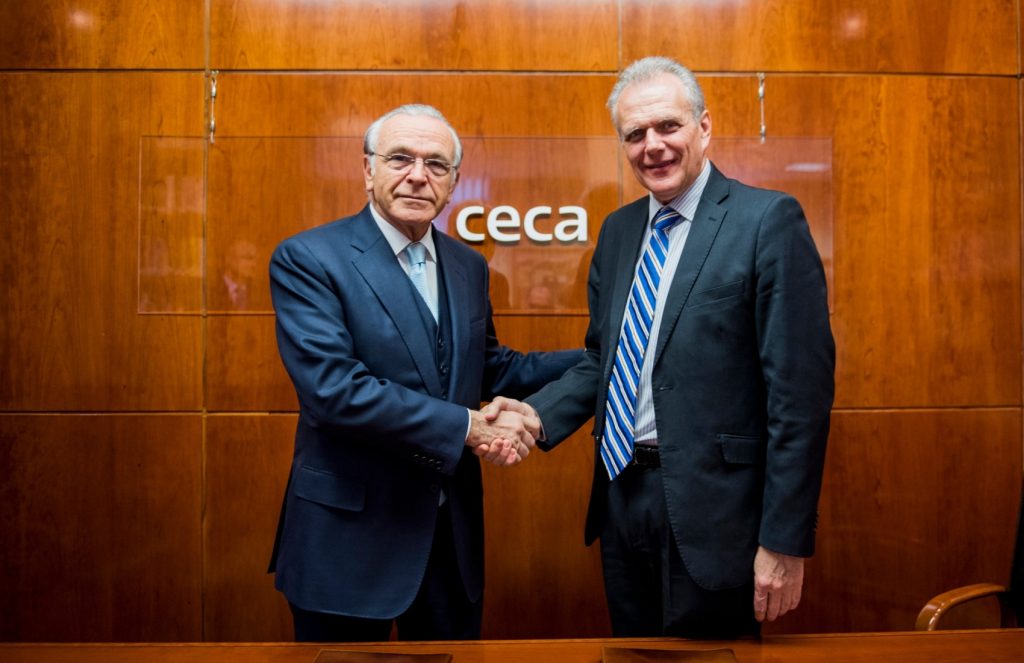
Madrid, February 19, 2015.- Banking entities, members of AEB (Spanish Banking Association) and CECA, will have access to the databases of “beneficial owners” and “publicly exposed persons, relatives or close associates of those” of the General Council of the Notariat, under the agreements signed between these entities and the notaries.
Both agreements respond to the banks’ interest in having an instrument that facilitates compliance with the obligation established by money laundering and terrorism financing prevention regulations to know the beneficial owner of bank accounts or other operations,
as well as to identify among their clients the publicly exposed persons.
Thus, Royal Decree 304/2014 states that obligated parties may access the files created under Article 15.1 of Law 10/2010 by other obligated parties, by the centralized prevention bodies established by national professional organizations, or by third parties.
Under these agreements, banking entities interested in accessing these databases may sign an individual agreement with the General Council of the Notariat, for which purpose AEB and CECA will disseminate among their members the existence of the respective agreement.
Moreover, two committees will be created, one between AEB and the Notariat and another between CECA and the Notariat, which will be responsible for the application of the agreement, the resolution of incidents that may arise, and for proposing
to the Ministry of Economy possible measures related to the money laundering and terrorism financing prevention agreement.
The Notaries’ Databases
The General Council of the Notariat created the databases of beneficial owners and publicly exposed persons, relatives or close associates of the latter in March 2012, in compliance with the provisions established in Royal Decree 304/2014.
This file was published in the Official State Bulletin on April 28, 2012, and was registered in the General Data Protection Registry on July 11 of that year.
Notaries play a decisive role in the control and prevention of crimes such as money laundering. The General Council of the Notariat established the Centralized Prevention Body for Money Laundering (OCP) in December 2005 to intensify and channel their collaboration with Public Administrations in this matter. In these almost ten years, the collaboration of notaries has been crucial in preventing this type of crime. The OCP has strengthened the Notariat’s collaboration with the Executive Service of the Prevention of Money Laundering and Monetary Offenses Commission (SEPBLAC) and with judicial authorities, greatly facilitating the individual work of the notary.
Spanish Banking Association and CECA
AEB and CECA pay special attention to supporting and coordinating their associated banks and savings banks in the prevention of money laundering, as well as to collaborating with the Administration in this area of action. The prevention of money laundering and the financing of terrorism is a priority activity for the members of both associations, both for their social responsibility and for the need to comply with the obligations imposed by current Spanish legislation in this area, which is one of the strictest in the European environment. Therefore, Spanish banks dedicate substantial operational and organizational resources to the detection and prevention of operations related to money laundering, in close collaboration with SEPBLAC, as the executive responsible for public action in this area.
Others Press Releases

Simplifying regulation would increase the banking sector’s financing capacity in Spain by €250 billion

The Social Work of the Entities Associated with CECA Exceeds 1 Billion Euros in Investment, a Figure that Reaffirms their Role as Promoters of Well-being and Economic Growth