

CECA Celebrates Its 110th General Assembly
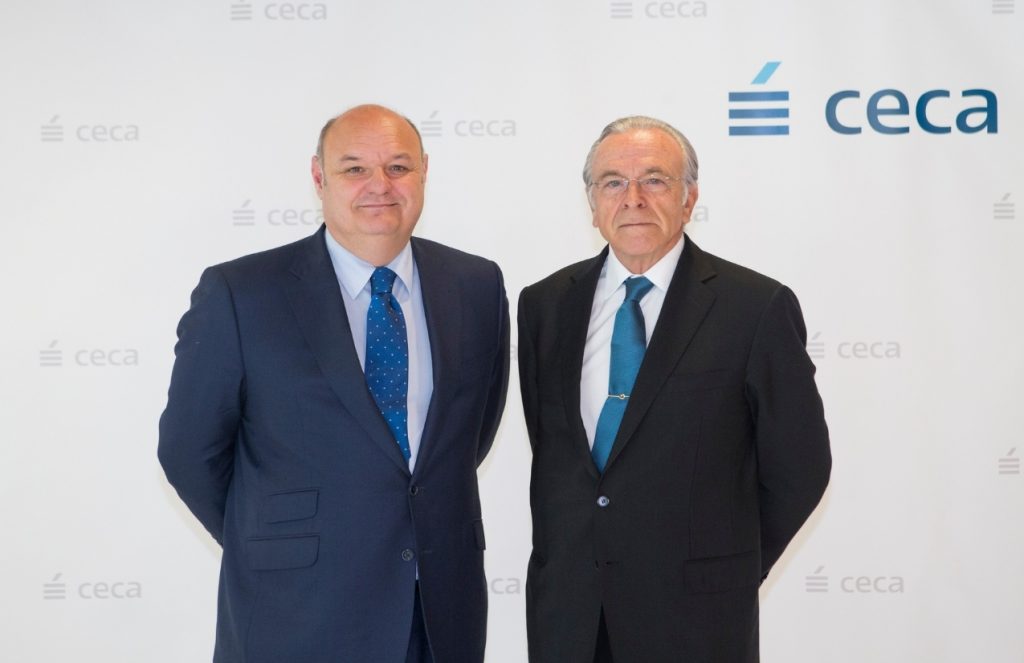
The President, Isidro Fainé, emphasized the need to reduce litigation and preserve legal security in mortgage regulation.
He highlighted the contribution to the Spanish public coffers made by CECA entities, which amounted to €4.866 billion in 2016.
CECA held its 110th General Assembly today, presided over by Isidro Fainé. The event was attended by the highest representatives of the banks, savings banks, and foundations affiliated with CECA, which account for 38 percent of the Spanish financial system in terms of deposits.
Financial and Economic Review
In his speech to the General Assembly, Fainé referred to the good performance of the Spanish economy, which, in line with Funcas projections, registered a growth of 3.2 percent in GDP, driven by demand, the external sector, the dynamism of exports, and the extraordinary performance of tourism.
During the event, there was also a review of the evolution of the financial environment over the past year. In this context, Isidro Fainé stated that “the efforts of restructuring, recapitalization, and consolidation carried out by Spanish entities place them in a more favorable position compared to other banking systems,” as demonstrated by the latest data from the European Banking Authority (EBA), which ranks it among the most efficient in the European Union.
However, the President of the Association reminded that there are still challenges the sector must face, such as continuing to strengthen solvency levels. In this regard, he noted that the increase in solvency requirements and other mechanisms such as MREL (Minimum Requirement for Eligible Liabilities) exert “additional pressure on the sector’s profitability.”
For 2017, he expressed CECA’s willingness to collaborate with the regulator to continue reducing litigation in mortgage processes and to enhance legal security through a “comprehensive reform of mortgage regulation that clarifies the rules of the game.” In this way, entities will be able to focus on granting mortgage credit within a system, the Spanish one, that has favored access to home ownership for millions of Spanish families, thanks to its good functioning, competitive interest rates, and long terms.
Total Fiscal Contribution in Spain
One of the main innovations of the Assembly was the presentation of a study on the Total Fiscal Contribution of the entities affiliated with CECA, which was developed together with PwC. The report concluded that in 2016, the contribution amounted to €4.866 billion, of which €2.255 billion corresponded to borne taxes, i.e., those that represent a cost for the entity and affect its results, and €2.611 billion to collected taxes, i.e., those that are withheld or passed on to third parties. CECA entities are characterized by almost entirely developing their activity in Spain, which highlights the importance of their contribution through taxes. Fainé assured that the entities represented by CECA have only “Spain risk, provide their services here and pay their taxes here.”
Thus, during the fiscal year 2016, the Total Tax Rate of the CECA sector rose to 38 percent. This means that for every 100 euros of profit before borne taxes, 38 euros were allocated to tax payments.
CECA, ESBG, and Social Work
Furthermore, Fainé emphasized the important role the Association plays internationally, promoting the Retail Banking model within the EU and maintaining a commitment to inclusion and financial education: “CECA has supported actions carried out through ESBG (European Savings Banks and Retail Banks Group) and WSBI (World Savings Banks Institute), participating in multiple meetings with representatives of various European authorities,” he noted. “This international activity of CECA has allowed us to convey to international authorities the sector’s concerns regarding regulation and supervision,” he added.
Coinciding with the General Assembly, the Commission on Foundations and Social Work took place, where the Social Work Report for 2016 was presented. In this period, the entities associated with CECA continue to be the largest private social investor in Spain, having allocated over €734 million to improving citizens’ welfare, which represents a 2.3 percent increase compared to 2015. This investment has enabled the execution of 102,132 activities, an 11.8 percent increase from the previous year, benefiting more than 30 million people.