

CECA and Universidad Pontificia Comillas Present the First Chair of Banking Regulation in Spain
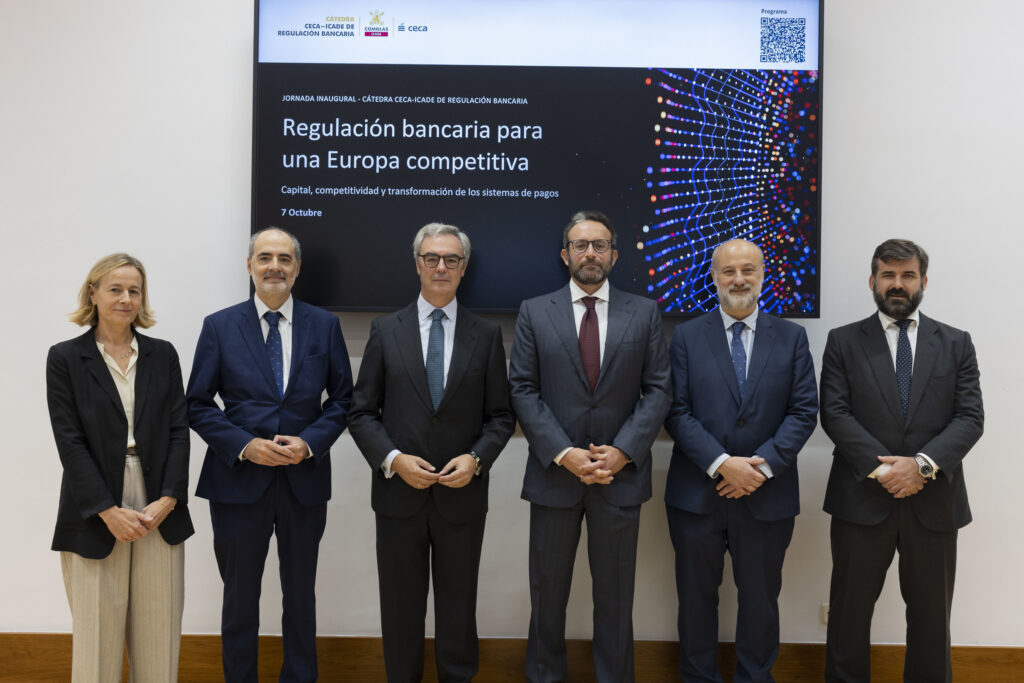
- The presentation of the Chair took place during the event ‘Banking Regulation for a Competitive Europe’
- Representatives from the European Commission, the Ministry of Economy, and the banking sector discuss European competitiveness
CECA and the Faculty of Economic and Business Sciences (Comillas ICADE) of Universidad Pontificia Comillas held the event ‘Banking Regulation for a Competitive Europe’, where they publicly presented their Chair of Banking Regulation, the first of its kind in Spain.
Emiliano Tornese, head of the Financial Macroeconomics and Macroprudential Policy Unit of the European Commission; Ana Puente, Deputy Director General of Sustainable and Digital Finance of the Ministry of Economy, Trade and Industry; José Sevilla, President of Unicaja; Matthias Bulach, Director of Accounting, Management Control, and Capital of CaixaBank; Luis de Guindos, former Vice President of the European Central Bank (ECB); and Antonio Romero, General Director of CECA, participated in the presentation event.
From Comillas ICADE, Javier Márquez, Dean of the Faculty of Economic and Business Sciences; David Tercero-Lucas, Professor of the Department of Economics; Jorge Díaz Lanchas, Director of the Department of Economics in the Faculty of Economic Sciences; Enrique Marazuela, Director for Economic Affairs and Relations with Companies of Universidad Pontificia Comillas; and Abel Benito Veiga Copo, Dean of the Faculty of Law, took part as well.
The presentation of the Chair was conducted by José María Abad, Professor in the Department of Economics at Comillas ICADE, and Teresa Herrero, Director of Studies at CECA, both co-directors of the Chair.
Antonio Romero, General Director of CECA, emphasized the value of creating this Chair and spaces for reflection “in an environment dominated by speed, immediacy, and growing complexity.”
“Financial regulation has a direct impact on the ability of entities to finance businesses and families, on the efficiency with which they channel savings into investment, and ultimately, on the competitiveness of the European economy. Therefore, it is essential to promote a rigorous analysis of its economic effects and to contribute to ensuring that public debate is increasingly based on evidence and less on perceptions,” he added.
Teresa Herrero, Director of Studies at CECA and co-director of the Chair, added that “the Chair has a clear mission to generate applied academic knowledge on the economic effects of banking regulation, with the intention of better substantiating the decisions made in the regulatory sphere.”
For his part, Javier Márquez, Dean of the Faculty of Economic and Business Sciences (Comillas ICADE), stressed that “the university has a long tradition in training professionals in the financial sector, and with this Chair, we take another step: we want to be a reference in research on its regulation as well. Collaboration with CECA will also bring our students closer to the realities of the sector, including through internships, and will help us train the specialists needed by banks and supervisors in the coming years.”
Finally, José María Abad, Professor in the Department of Economics at Comillas ICADE and co-director of the Chair, pointed out that “banking regulation decisions have direct consequences on the financing of the real economy and the competitiveness of our entities, and should be supported by the best available evidence. This Chair was created to provide that evidence, with rigor and independence, and to be a meeting point where academics, supervisors, and professionals from the sector can discuss with data on the table. It also arrives at a key moment, with Europe reviewing its regulatory framework to gain competitiveness without renouncing financial stability.”
Competitiveness and Payment Systems
During the event, the importance of focusing on the competitiveness of the banking sector in the current challenging international context was highlighted, which has led to a reflection on the strategic autonomy of the European Union.
This was done by Emiliano Tornese, head of the Financial Macroeconomics and Macroprudential Policy Unit of the European Commission, and Matthias Bulach, Director of Accounting, Management Control, and Capital of CaixaBank, who participated in the first dialogue roundtable alongside José María Abad. The CaixaBank executive emphasized that the significant financing needs currently present in the European economy require a competitive banking sector. Meanwhile, the European Commission official highlighted the importance of European banks being able to operate cross-border and complete the integration of the Single Market, one of the biggest challenges facing the European Union today.
On the other hand, Ana Puente, Deputy Director General of Sustainable and Digital Finance of the Ministry of Economy, Trade and Industry; José Sevilla, President of Unicaja; and David Tercero-Lucas, Professor in the Department of Economics at Comillas ICADE, engaged in a dialogue regarding the transformation presently being experienced by payment systems, discussing trends such as asset tokenization, stablecoins, and the digital euro, in addition to the challenges the sector faces, such as the risk of dollarization in some emerging economies and its monetary implications.
Finally, Luis de Guindos, former Vice President of the European Central Bank, praised the strength of the European banking sector in terms of profitability, liquidity, and solvency, as well as the improvement of its valuations. He also noted that one of the sector’s challenges is the need to complete the Banking Union with the creation of a common deposit guarantee fund.
First Chair of Banking Regulation
The CECA-ICADE Chair of Banking Regulation is the first of its kind in Spain. The project aims to promote cutting-edge academic research on the economic impact of banking regulation and to provide rigorous evidence to the public debate.
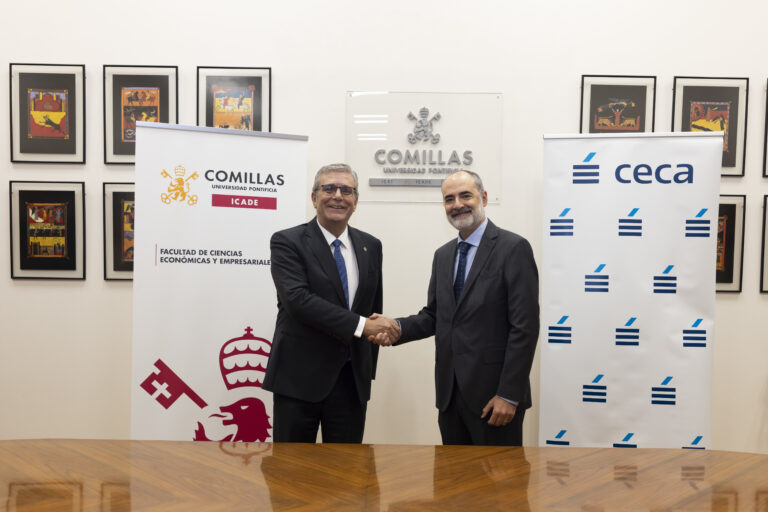
To implement it, both institutions signed a collaboration agreement on September 4. In parallel, the agreement will enable ICADE students to undertake curricular internships at CECA, thereby reinforcing the connection between the academic sphere and the professional reality of the financial sector.
The new Chair aspires to become a reference academic center in the economic analysis of banking regulation, with special attention to its effects on the activity of financial entities, the financing of the real economy, and the competitiveness of the financial sector.
Within the framework of the CECA-ICADE Chair of Banking Regulation, academic publications, conferences, and specialized seminars on banking regulation will be promoted. There are also plans to sign cooperation agreements with prestigious international universities to develop joint research and training projects.
Among the planned activities is the organization of an annual conference on banking regulation, which will bring together researchers, regulators, and professionals from the sector to foster technical dialogue and knowledge exchange.
During the 2026-2027 academic year, the Chair will focus a significant part of its research activities on analyzing regulatory simplification measures and improving banking competitiveness.
Among other areas, the effects of micro and macroprudential measures linked to capital requirements will be analyzed, as well as issues related to the Capital Markets Union and the Savings and Investments Union (SIU). Additionally, a specific line dedicated to the payment sphere will be promoted, with special attention to financial innovation associated with the digital euro, stablecoins, and tokenization.
Apart from its co-directors, the Chair includes an Advisory Council responsible for defining research lines at the beginning of each academic year and supporting the research team in project execution. This body comprises renowned professionals from the financial sector, with representation from CECA, FUNCAS, Comillas ICADE, and financial entities.