


The European Association of Savings Banks and Retail Banks Discusses the Role of Retail Banking in Economic Reconstruction

The Retail Banking Conference, titled “Coping with crisis thanks to deep local roots,” has brought together sector members, authorities, and supervisors, with notable Spanish representation, to discuss the role of retail banking in the crisis caused by COVID-19 as well as sustainable finance.
CECA is part of the European Association of Savings Banks and Retail Banks, where it holds the Vice-Presidency. This organization represents 25 associations in 20 European countries, totaling 885 credit entities, with more than 47,500 offices and 650,000 employees.
Today, the Conference of the European Association of Savings Banks and Retail Banks (ESBG) took place virtually due to the pandemic. The ESBG Retail Banking Conference is an annual event that this time focused particularly on the crucial role of retail banking in helping society cope with the crisis generated by COVID-19 while simultaneously becoming a fundamental pillar in reconstruction and sustainable finance.
The event was opened by the president of ESBG, Helmut Schleweis, who emphasized in his speech that society needs banking services more than ever at this moment: “We must contribute to the well-being of our societies, and this is not possible if the main goal is solely to maximize economic objectives.”
Several representatives from European Union financial policy participated in the meeting, including Andrea Enria, chair of the Supervisory Board of the European Central Bank. Enria debated with Chris De Noose, director of ESBG, in an initial session where they addressed the situation caused by COVID-19 from the perspectives of the supervisor and the banking sector, respectively.
Andrea Enria commented regarding the expected increase in delinquency caused by the economic halt due to the crisis that “we do not know exactly when the rise of NPLs will materialize, but it will depend on the future of the support lines implemented by the states. Therefore, we must be prepared.”
Various speakers from European savings bank and retail bank associations, such as the German DSGV, and high-ranking banking executives, including Jordi Gual, president of CaixaBank, participated in an interesting debate during the session “Retail banks facing the crisis: how lasting will the influence of coronavirus be?”. Jordi Gual explained that “we are experiencing a change of era. COVID-19 has accelerated the ecological transition and sustainable responses from companies. Our primary mission as an entity is to ensure the well-being of our customers and our society.”
During the session “Sustainable finance: a golden dawn after the Covid-19 darkness?”, future perspectives for sustainable finance after COVID-19 were debated. In this context, Santiago Carbó, director of Financial Studies at Funcas and independent advisor at Cecabank, emphasized that any strategy to be more sustainable or more digital must necessarily be socially inclusive.
Pablo Hernández de Cos, governor of the Bank of Spain and chair of the Basel Committee on Banking Supervision, answered three questions regarding the committee’s response to the COVID-19 crisis and future challenges, stating that “during this crisis we have worked to mitigate financial risks and absorb losses, provide credit to individuals and businesses, and ensure that financial institutions can operate normally. Banks must remain vigilant to the risks of the environment.”
The president of the European Banking Authority, José Manuel Campa, intervened via a video highlighting that “banks play an important role in supporting society.”
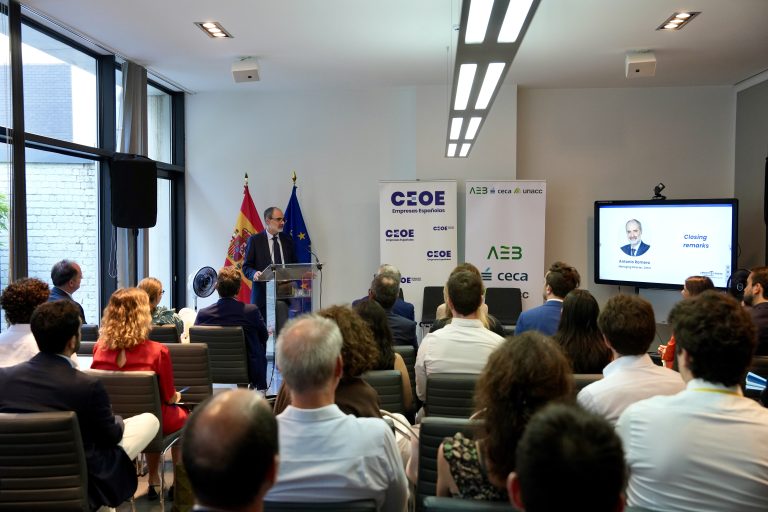
The closing remarks were made by Chris De Noose, who concluded the event by discussing sustainability: “The sustainable future ahead makes me think that we are facing a change of era.”