

CECA will allocate nearly 3.5 million euros to financial education projects in 2019, a 15% increase
CECA announces a 15% increase in the funding for the Funcas Program for Financial Education Stimulus, up to 3.5 million euros
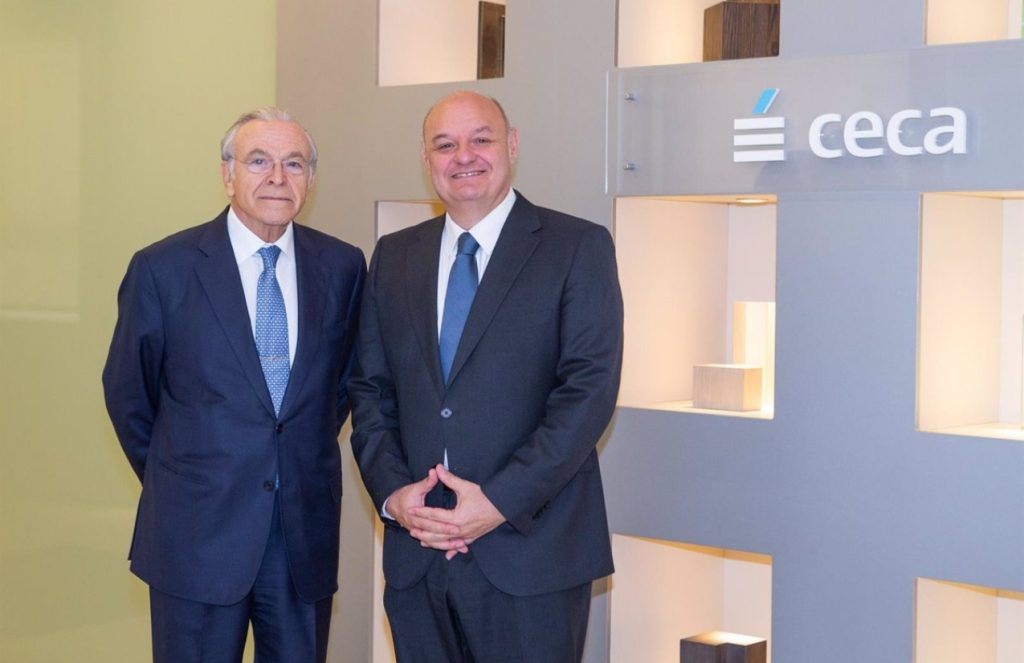
Isidro Fainé: “For CECA, its affiliates, and its foundation, FUNCAS, financial education must be a priority and with this vocation we work and put all our efforts.”
The investment in Social Work by the entities affiliated with CECA exceeded 813 million euros in 2018, a 2 percent increase compared to the previous year
CECA announced today a 15% increase in the budget allocated to financial education initiatives, resulting in nearly 3.5 million euros for the ‘Funcas Program for Financial Education Stimulus’ (“Funcas Educa”). This project, launched in 2018, aims to finance financial education activities through the affiliated entities, either directly or through their linked foundations, consolidating existing projects and promoting new ones.
This information was made public during the 112th General Assembly of CECA, inaugurated today by its president, Isidro Fainé. The highest representatives of the banks, cajas, and foundations affiliated with CECA attended. The 10 groups of credit institutions represented by CECA account for almost 40 percent of the total in the Spanish financial system in terms of deposits. In addition, CECA also groups 14 banking foundations and 15 general-purpose foundations.
Financial education as the key to the activity
CECA members highlighted during the Assembly the importance of financial education as one of the essential priorities of their activity. CECA invested a total of 3 million euros in financial education programs during 2018, allocated over 1,945 activities that benefited more than 8.5 million people.
In fact, today the first Financial Education Report has been presented, which collects the activities carried out by our entities and the Funcas Educa Program this year.
Nearly 18,000 volunteers participate in financial education programs in Spain, making it possible for the sector to be a benchmark in promoting this subject, thanks to the extensive network of affiliates throughout the national territory. Thus, they manage to reach all segments of the population considering their characteristics and adapting the programs to their needs with appropriate language for understanding.
In Fainé’s words: “For CECA, for its affiliates, and for its Foundation, Funcas, financial education must be a priority and with this vocation, we work and put all our efforts.”
José María Méndez, General Director of CECA, explained: “Financial education is a key lever to regain clients’ trust and is also a great tool to fight against exclusion, thus promoting the well-being of society.”
Social work, once again at the forefront of private social investment in Spain
Prior to the Assembly, the Commission of Foundations and Social Work took place, a meeting that brings together the foundations linked to the entities affiliated with the association and advises the Board of Directors on Social Work matters.
This year, the Commission was attended by the Minister of Culture and Sport, Mr. José Guirao, who in his opening speech highlighted that “CECA is a nucleus of thought and reflection of innovative proposals because it combines financial and social thinking. It must work for the future by providing new innovative models of work, reflection, and functioning so that Spanish society can face future challenges.”
The investment in Social Work in 2018 consolidates another year of positive trend, reaching more than 813 million euros (representing a 1.56 percent increase compared to the previous year), with the development of more than 120,000 activities that have cumulatively benefited over 35 million people.
This allocation leads the sector to lead private social investment in Spain, an irreplaceable lever for change in society and one of the main sources of development aid and equal opportunities among the most vulnerable groups.
In the words of the Minister of Culture, “Social Works innovated in social intervention, distributing help to non-profit organizations, promoting cultural activity, and establishing their own action models. In addition, they generated a new form of participation by creating a different ecosystem of interaction among the various community actors. Social Works have been and are a fundamental driving force in the approach to social actions, pioneering in distributing resources and establishing their own direct intervention models with the public.”