

Isidro Fainé successfully concludes three years at the helm of the ESBG and is proposed to preside over the World Institute of Retail Banking (WSBI)
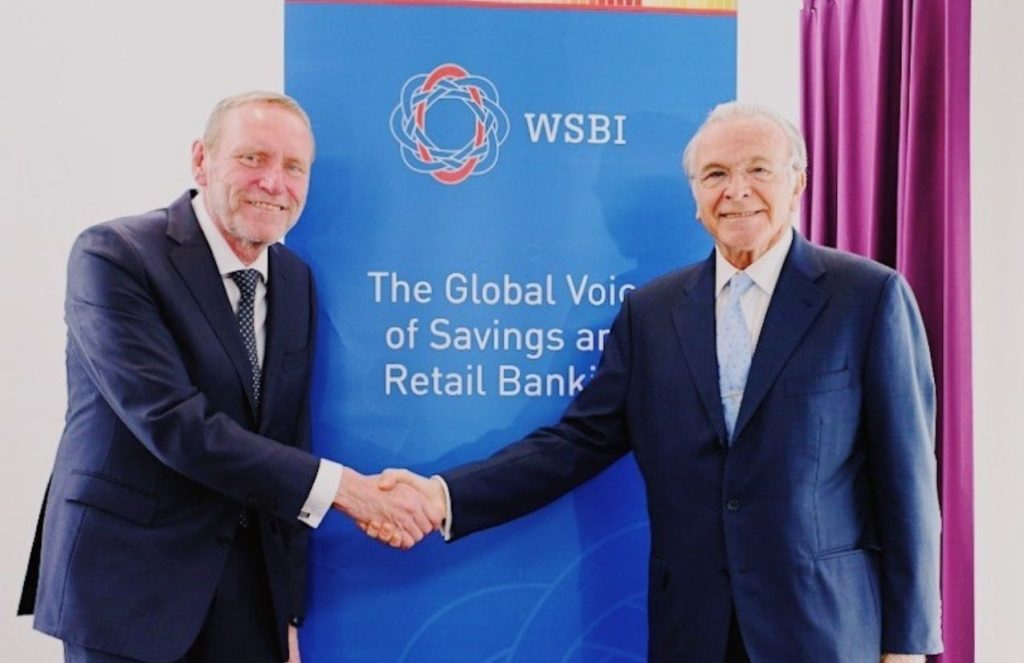
Fainé will remain closely linked to the European Association of Savings and Retail Banks (ESBG) having been appointed today as vice president of the institution.
The president of CECA and the ”la Caixa” Banking Foundation is the candidate proposed by the European association to preside over the World Institute of Savings Banks and Retail Banks (WSBI).
Isidro Fainé, president of the Spanish Confederation of Savings Banks (CECA) and the ”la Caixa” Banking Foundation, has been designated today as vice president of the European Association of Savings and Retail Banks (ESBG), at the end of his three-year presidency, as established by the institution’s regulations. During the 30th Board of Directors meeting held in Brussels, the ESBG appointed Helmut Schleweis, current president of the German Savings Bank Association, as his successor.
Candidate for the presidency of the WSBI
The end of his mandate as president of the ESBG allows this to present Isidro Fainé’s candidacy as president of the World Institute of Savings Banks and Retail Banks (WSBI). In this regard, Fainé will be a candidate to preside over this entity representing the European grouping starting next November. The presidency of this institution would entail the assumption of a new global responsibility in defending and promoting the interests of savings and retail banks around the world and all their clients.
The WSBI represents the interests of 7,000 savings banks and retail banks around the globe. The functions of this institution, founded in 1924, are focused on representing these interests before international organizations, such as the IMF, the Bank for International Settlements, the Basel Committee, and the International Organization of Securities Commissions (IOSCO), among others.
The WSBI focuses on globally relevant issues affecting the banking industry, supporting the G20’s objectives of achieving sustainable, inclusive, and balanced growth, as well as job creation worldwide, both in industrialized and less developed countries. Furthermore, the WSBI prioritizes international efforts to advance financial access for all.
In figures, WSBI members hold a total of 15 trillion euros and serve 1.3 billion clients in nearly 80 countries that offer retail banking services.
Three years at the helm of the ESBG
Fainé has been the first Spanish president of the ESBG, and his mandate has marked important milestones, both for international banking and internally. His presence in one of the main European associations has prominently projected the transformation that the Spanish banking sector has experienced in recent years.
Throughout his participation in the European association, Fainé has maintained an intense agenda of high-level meetings with international financial authorities such as the International Monetary Fund, the European Central Bank, the Single Supervisory Mechanism, and the European Commission, with the aim of discussing the most relevant regulatory issues for the retail banking sector.
Additionally, changes have been made within the institution that have significantly influenced the evolution of the organization. A refocusing of the association’s structure, with a new push towards digitization and the creation of a new internal code of conduct, are just some of the reforms that have been implemented under Fainé’s presidency.
“Highlighting the client relationship”
During the 30th Board of Directors meeting, Isidro Fainé emphasized the decisive role of retail banking in the fight against exclusion and poverty: “A special sensitivity towards social issues, and our involvement in solving them, is what differentiates both the ESBG and the WSBI. We aim, through our attitude and our activities, to enhance our reputation and underline the important social function we fulfill. Moreover, we are obliged to demonstrate to society and the authorities of each country, through projects and actions, that solutions to the major problems exist and are within our reach.”
Furthermore, Fainé highlighted the sector’s commitment to seeking solutions to the major challenges of the future. “We want to be a first-order player, at an international level, in formulating proposals, designing initiatives, and executing concrete programs,” he indicated. In his view, the key and challenge for the continuity of retail banking lies in “valuing our model of relationship with clients, as opposed to other models based on disintermediation or virtual technologies. Only in this way can retail banks compete with fintechs and bigtechs, the large technology companies that dominate the global information market.”