


CECA and DSGV reaffirm their partners’ commitment to financing SMEs
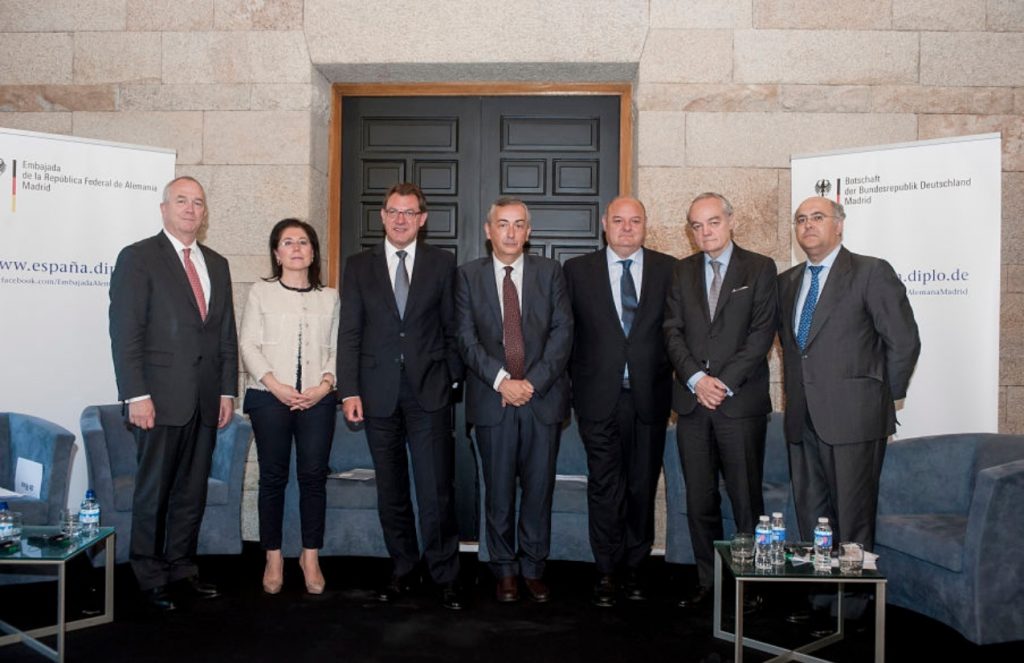
CECA and DSGV participated in a meeting organized by the German Embassy in Madrid to discuss the expectations and challenges of financing SMEs
In 2016, new credit to Spanish SMEs is growing at a rate of 19%
The German Ambassador to Spain, Mr. D. Peter Tempel, welcomed representatives from the General Secretariat of the Treasury and Financial Policy, the German Savings Banks Association (DSGV), CEPYME, AEB, and CECA, to discuss the role of credit institutions in financing SMEs in Europe. The event underscored the relevance of SMEs within the Spanish and European business landscape and the need to ensure adequate financing for them. The DSGV was represented by its Executive Director of the Board, Karl-Peter Schackmann-Fallis. CECA was represented by its General Director, José María Méndez.
Both associations, DSGV and CECA, are part of the European Association of Savings Banks and Retail Banks (ESBG), chaired by Isidro Fainé, and the World Savings and Retail Banking Institute (WSBI). All entities integrated into ESBG-WSBI share a common vision of banking, where financing families and SMEs constitutes a fundamental axis of action and identification.
In fact, José María Méndez emphasized the special support provided to SMEs by the entities associated with CECA in recent years. Specifically, these entities lent 22.7 billion euros to the SME sector during 2015. Throughout 2016, there is a recorded increase of 19% in new credit to small and medium-sized enterprises, reflecting a strong commitment to this sector, which is key for the recovery of the Spanish economy.
The General Director of CECA argued that credit institutions are and will continue to be the main source of stable financing for SMEs, but it is essential that the regulatory framework is sensitive to the needs of this sector and its importance to the overall economic system. In this regard, among other measures, he advocated for the maintenance of the SME corrective factor, which allows financial institutions to benefit from reductions in capital consumption on exposures to this type of company. He also defended the need to adopt structural measures that encourage the growth of the size of Spanish SMEs.
Moreover, Méndez highlighted the change in the credit mix by productive activities in Spain. While in 2008, 60% of financing was granted to companies related to construction, in 2015 this sector represented only 38% of the total.
For his part, Mr. Dr. Schackmann-Fallis focused his remarks on the financing of SMEs and business groups in rural areas and on the significance of proximity to the customer. “The [decentralized banking system has the advantage] that savings banks know their customers particularly well and always seek solutions with them. Only a positive outcome for both parties, clients and savings banks, guarantees economic security.”