


AEB, CECA and Unacc present the roadmap of measures to ensure total financial inclusion
The banking sector agrees on a new framework of commitments regarding services in rural areas, with solutions for municipalities that lack a physical point of access to financial services or have one, with strict adherence to competition regulations.
This new roadmap, developed in coordination with the Ministry of Economic Affairs and Digital Transformation, also establishes mechanisms for monitoring the commitments and updating information.
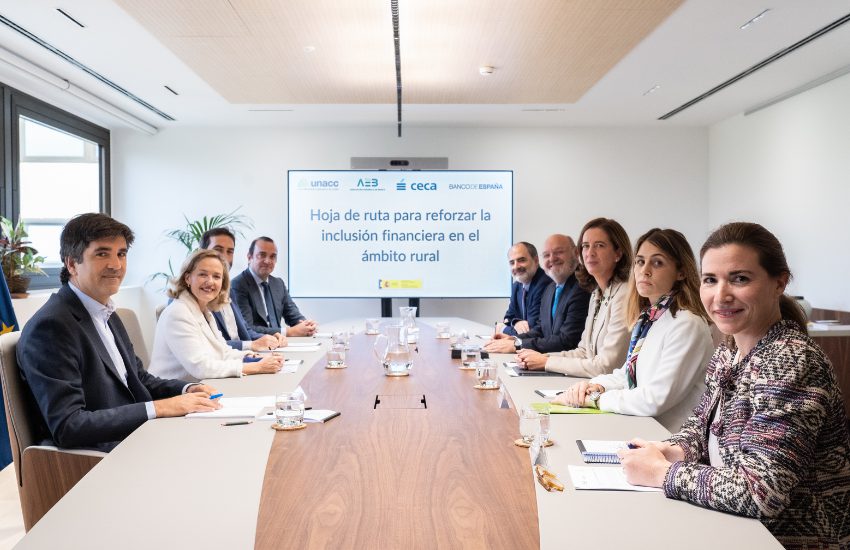
MADRID. Friday, October 7, 2022. The Spanish Banking Association (AEB), CECA, and the National Union of Credit Cooperatives (UNACC) presented today a roadmap to strengthen financial inclusion in rural areas, with the aim of ensuring adequate provision of physical financial services for 100% of Spanish territory. The agreement, presented this morning at the meeting with the first Vice President of the Government and the Minister of Economic Affairs and Digital Transformation, updates and reinforces the social and sustainable commitment of the banking sector.
The proposed measures advance financial inclusion, addressing issues arising from depopulation, which are transversal and affect large areas of the country. Therefore, it is proposed that the deployment of the planned actions be developed within a broad framework of public-private collaboration, under the same premises and objectives, to find the most efficient solutions to the heterogeneity of the circumstances in rural areas of Spain.
In this regard, the financial sector is reinforcing financial inclusion in these areas and has worked in coordination with the Ministry of Economic Affairs and Digital Transformation to agree on a new framework of commitments with rural Spain, which will be articulated with full respect for competition regulations and will be communicated to the National Commission on Markets and Competition. The objective is to ensure physical access to financial services in all Spanish municipalities, prioritizing those that currently lack any physical access point or have only one. This roadmap allows for achieving total financial inclusion that offers a physical access point to banking services in municipalities that have never had one before.
Thus, in those municipalities where there is no physical access point to financial services, a commitment is made to guarantee assistance through a bank office, an ATM, a mobile office, and a financial agent in municipalities with more than 500 inhabitants. Along with this, in municipalities with fewer than 500 inhabitants, solutions such as cashback or cash-in-shop will be offered for cash withdrawal through state-of-the-art point-of-sale terminals (POS), so that these services can even be enhanced in the medium term and provide access to a larger number of services. Additionally, the service of rural mail carriers will be offered through the Correos Cash service, under the collaboration agreement that AEB, CECA, and Unacc signed with Correos on July 20, which has so far been joined by seven entities.
On the other hand, in the case of municipalities with only one access point to financial services, the entities will make their utmost effort to maintain them. If it is not possible, it will be referred to the Financial Inclusion Observatory for its incorporation into the annual diagnosis and the objectives developed in this roadmap.
These actions will be complemented with electronic and telephone banking services developed by financial entities to attend to those customer segments who prefer digital applications, for which the three banking associations have promoted financial and digital skills for the entire population for years.
Information regarding accessibility to financial services in Spanish municipalities is based on the “Report on Financial Inclusion in Spain,” produced by IVIE and presented by the banking associations in July of this year, which estimates that 1.4% of the population lacks access to a point of banking services. The data corresponding to municipalities with more than 500 inhabitants lacking accessibility will be published as an Annex in the aforementioned report on financial inclusion, and the lists will be updated annually based on data provided by the entities.
To facilitate this updating and monitoring effort, a mailbox will be made available to local entities starting Monday, October 17, at the email address consultas@observatorioinclusionfinanciera.es, under the framework of the Financial Inclusion Observatory, so they can request information, clarify doubts, submit requests, and communicate inaccuracies or necessary corrections to that list.