


READING MATERIALS OF INTEREST
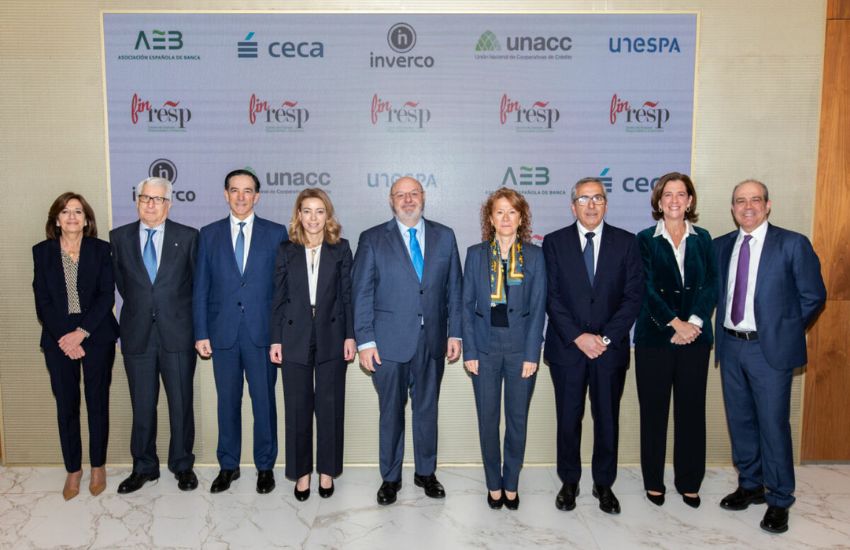
FINRESP, the Center for Sustainable and Responsible Finance in Spain, along with its promoting associations – AEB, CECA, INVERCO, Unacc, and UNESPA – held its fourth annual event today, aiming to address the main national and international perspectives and strategies regarding Sustainable Finance, as well as the challenges and opportunities currently presented in Spain and the role of SMEs concerning the advancement of sustainable transformation, among other issues.
The president of FINRESP and general director of CECA, José María Méndez, delivered the inaugural speech, highlighting the sector’s willingness to collaborate on the future Sustainable Finance Plan and the Green Book of sustainable finance that the Government plans to launch: “We are facing a great challenge that requires maximum collaboration between public and private bodies for a sustainable transition. This effort requires resources and plural cooperation spaces that also reflect the reality of the sector.”
In this regard, the event featured the institutional presence of Paula Conthe, Secretary General of the Treasury and International Financing, who participated in closing the event, emphasizing the creation of an advisory council as a meeting point for public-private collaboration, and noted in her speech that “in the coming weeks, a public consultation will be opened regarding the Green Book, which is in the final drafting phase.”
A Commitment to Joint Action from All Economic Agents
The objective of the meeting was to analyze and discuss the main lines guiding the development of sustainable finance in Spain by the main actors in the financial system. To this end, FINRESP included representatives from the sector, as well as regulatory and supervisory bodies and profiles from the business environment.
The first panel, focused on “The New Political Course in Spain: Challenges and Opportunities,” was moderated by Méndez. It addressed the risks and transparency of the financial sector, evaluating the efforts made thus far and future challenges. The discussion highlighted the sector’s role as a source of financing for a productive model compatible with environmental preservation. The panel featured participation from Montserrat Martínez, Vice President of the CNMV, who pointed out the speed at which the regulatory model has developed and the need for appropriate tools to implement it. Additionally, José Carlos García de Quevedo, President of ICO, and Margarita Delgado, Deputy Governor of the Bank of Spain, noted that: “Our fundamental objective is to promote a profound transformation to mitigate climate risks related to this transition in the economy.”
Secondly, Ángel Martínez-Aldama, President of Inverco, led a panel alongside Helena Viñes, President of the Sustainable Finance Platform, and Antonio Santoro, Southern Europe Director at Principles for Responsible Investment (PRI), discussing the ‘European Sustainable Finance Strategy, its Balance and Perspective.’ During the session, Helena emphasized the positive results of the sustainable finance strategy and the European roadmap, despite criticisms. In this regard, Antonio Santoro pointed out that “the plan has been ambitious, and investors now have tools to align with the regulations and develop good practices, with a positive market response.” For his part, Martínez-Aldama highlighted three relevant issues: “the importance of public-private collaboration; the need to strengthen involvement between financial sector entities and regulators; and the role of PRI as pioneers in the implementation of principles that were merely voluntary before regulation existed.”
The third debate was guided by Mirenchu del Valle, President of UNESPA. This panel also collaborated with Elena Sanz, CEO of Mapfre Iberia, and Fausto Parente, Executive Director of EIOPA. Elena Sanz highlighted the increase in adverse climate phenomena, both in Spain and other countries, stating: “We are facing a number of disasters never seen before, with greater frequency, volatility, and cost.” In this context, Fausto added that: “People need to understand the problem posed by climate change. There is much scope for public-private cooperation.” Likewise, del Valle agreed that “climate risks and pensions are the two areas where the deficits of societal protection are most visible.”
On the other hand, Alejandra Kindelán, President of AEB, led a dialogue emphasizing sustainability management, risks, and financing, where entities play a fundamental role in supporting companies. To analyze these topics, she welcomed Héctor Grisi, CEO of Santander Global; and Fernando Restoy, President of the Financial Stability Institute. On another note, Grisi emphasized the role of banks and how “sustainability is always at the center of discussions with clients, in different countries and regions, so it has become a global matter.” Kindelán agreed, adding that “the green transition is a factor of growth and competitiveness.”
Jerusalem Hernández, a partner of Sustainability and Good Governance at KPMG, moderated a panel with Antón Arriola, President of Kutxabank, and Aniceto Zaragoza, General Director of OFICEMEN, discussing the role of the sustainable transition in decarbonization. Arriola stated that “Kutxabank has a sustainable DNA in its structure, where we work with our foundations to develop sustainability-focused activities and with more than 1 billion to carry it out.” Similarly, Zaragoza emphasized that: “value is generated in clients, who require more sustainable and decarbonized products and construction. Tools such as footprint calculation help to give value to the efforts we are making.”
The Role of SMEs and Their Perspectives on the Challenge of the Sustainable Transition
During the last phase of the event, the situation of SMEs and their challenges in a context marked by the sustainable transition were addressed. Under the theme: ‘The Real Economy and SMEs Facing the Sustainable Transition Challenge,’ Manuel Ruiz, President of Unacc, was joined by prominent figures from the Spanish productive fabric such as Luis Aribayos, Secretary General of CEPYME, and David Bernabéu, CEO of Citibox. Aribayos highlighted that: “It is essential to understand the reality of ESG criteria in SMEs. To achieve this, we must rely on the data from the productive fabric to make informed decisions.” Conversely, Ruiz emphasized “the need for sustainability to be profitable for SMEs and highlighted the added value of the Sustainability Observatory that FINRESP is developing to provide data to tackle these challenges.”
Furthermore, during the debate, the upcoming disclosure of the results of the first edition of the Sustainability Observatory in SMEs, prepared by FINRESP in collaboration with CEPYME, was announced. This report will allow for an understanding of the degree of adaptation of Spanish SMEs to regulation and the expectations for the sustainable transition. The project will be published soon. In this regard, Bernabéu stressed the importance of the Observatory as it “provides key aspects, such as access to financing for environmental projects in SMEs or the search for a path to transition from theory to practice.”
These cookies are essential for the website to function and cannot be disabled. They are generally set in response to actions made by you, such as setting your privacy preferences, logging in or filling in forms.
They enable enhanced functionality and personalisation, such as videos, live chat, preferred language and region.
They allow us to count visits and traffic sources in order to measure and improve the performance of our site. They help us to know which pages are the most and least popular.