


READING MATERIALS OF INTEREST
Projects with environmental, social, and governance vision are those that will achieve the most investment
Investment in sustainable finance has a regulatory framework that is becoming increasingly specific. The European Commission has been advancing in this area since it launched the action plan in 2018 to redirect capital flows towards improving society and the planet, managing the financial risks arising from climate emergencies and social issues, and promoting maximum transparency and long-term responsible vision in financial and economic activities.
To continue fostering sustainable investment, less than a month ago, the European Commission presented a new package of measures, which it hopes to implement starting January 2024. This includes new rules for environmental, social, and governance (ESG) rating providers, so that companies wishing to invest in their transition towards sustainability can do so with greater guarantees.
Responsible investment has an increasingly concrete regulatory framework
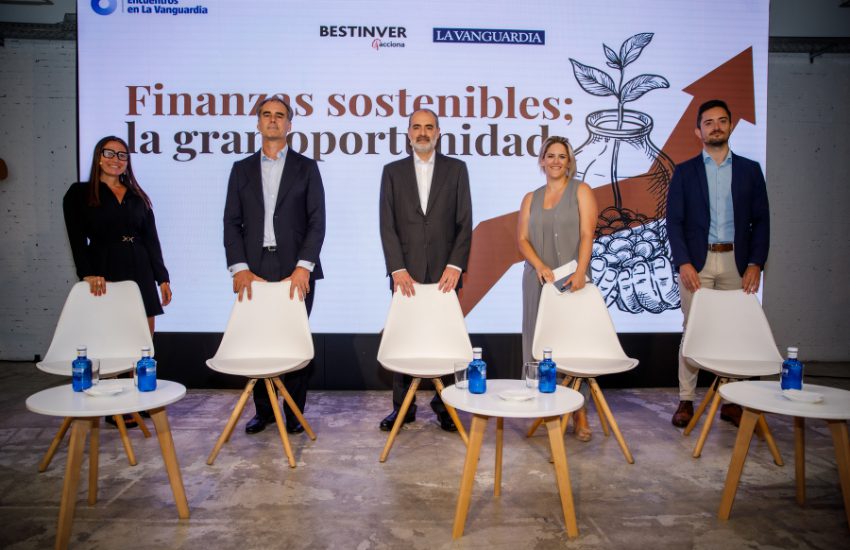
Despite the increase in ESG investment, which currently reaches 25%, the steps being taken are still insufficient to achieve the Sustainable Development Goals (SDGs) established by the United Nations. In this context, experts consider it essential that, in addition to having an adequate regulatory framework, there is more advisory support in sustainable finance to make its advantages known to the business and investor community, as emphasized in the Encuentros en la Vanguardia session, which was collaborated on by Acciona and held under the title “Sustainable Finance: The Great Opportunity.”
The round table, held on Tuesday, June 27, at Espacio 23 in Madrid, was accessible both in person and via streaming through the newspaper’s website. It featured contributions from Javier Molero, Director of Projects and Agenda 2030 at the UN Global Compact; Antonio Romero, Executive Committee Member of Finresp; Andrea González, General Director of Spainsif; and Federico García Guillén, Director of Development and Strategic Projects at Bestinver.
“The global commitment to sustainability involves a transfer of investment and a repositioning towards projects aligned with the goals we have set, including a carbon-neutral model by 2050,” García Guillén highlighted. Acciona, the group to which this investment manager belongs, is determined to “lead this change” with its commitment to sustainable finance, including renewable energy, García Guillén emphasized, whose firm manages assets of more than 5 billion euros.
Experts call for specialized advisory in these products
Javier Molero, Director of Projects and Agenda 2030 at the UN Global Compact, warned that “we are at a critical moment” that requires the promotion of initiatives that enable compliance with the Sustainable Development Goals (SDGs).
In many of its areas of action, including the fight against poverty or the climate emergency, not only is there no progress, but there is also regression. “Hunger is on the rise, as are greenhouse gas emissions,” lamented Molero. With less than eight years until 2030, the Director of Projects and Agenda 2030 at the UN Global Compact reminded that “the growth of sustainable finance can accelerate the necessary transformation.”
Andrea González, General Director of the non-profit association Spainsif, which brings together over a hundred actors in the sector—including financial entities, insurance companies, service providers, universities, and labor unions—also highlights the “evolution” she observes in sustainable finance towards greater “democratization,” in the sense that there is an increasing number of sustainable financial products adapting to each investor based on a “suitability test” after analyzing their return and risk preferences.
In areas such as the fight against poverty or the climate crisis, regression is seen
In Andrea González’s opinion, the European regulator is “pioneering” as it considers not only investment in projects that are already sustainable but also financing the transition of many companies towards a new model.
Helping the productive fabric is key for Antonio Romero, member of the Center for Sustainable and Responsible Finance in Spain (Finresp). The objective of Finresp is to incentivize the sustainability strategies of small and medium-sized enterprises, seeking to provide useful solutions that facilitate their transition. Currently, a pilot project is being worked on with Cepyme to offer SMEs in six specific sectors an assessment of their environmental, social, and corporate governance parameters to help them understand their positioning compared to other comparable companies.
Antonio Romero believes that the action plan initiated in 2018 marked a “turning point,” after which “the financial sector is a key instrument to channel the necessary investments” to achieve sustainability goals. “The taxonomy is a consensus on what is sustainable or not, generating confidence in the regulatory framework that protects the investor,” he added.
Scientific rigor and the fight against ‘greenwashing’ is one of the sector’s challenges
Advisory support is the primary recommendation experts offer to both investors choosing sustainable finance and companies aiming to secure this type of funding. Companies must “prepare to organize their sustainability strategy” with respect to compliance with “new directives,” explained Javier Molero. The three most imminent, he emphasized, are the life diligence directive to identify their social and environmental impacts and implement measures to mitigate them; the sustainability information directive, which Javier Molero described as “very relevant,” as it will require organizations to report the same indicators in their sustainability reports, thereby allowing for unified criteria; and the directive related to the so-called ‘greenwashing’ to avoid false marketing that ensures their information is based on scientific verifications. “Sustainable finance is an economic opportunity, but also a social and planetary one,” he assured.
“We must consider sustainability, also in the consumption of financial products,” urged Andrea González, General Director of Spainsif, who also advocates for being “activist” as products are currently designed ad hoc for each operation.
“Let us back projects with the greatest transformative impact,” González urged. We must achieve “a just transition that will not compromise the prosperity we have attained but will enhance it in the long term,” assured Executive Committee Member of Finresp, Antonio Romero.
“The company that can lead a transformation will attract more investment flows,” predicted Federico García Guillén, Director of Development and Strategic Projects at Bestinver. However, the current difficulty experts face, especially regarding governance issues, lies in “having comparable information between companies,” García Guillén warned.
Despite this, the Bestinver executive confirmed that “giant steps are being taken.” “Sustainability is an inexorable challenge that requires funding and presents great opportunities for companies and investors,” was the “optimistic” message with which the Director of Development and Strategic Projects at Bestinver concluded his intervention in the debate.
Round Table
Javier Molero, Director of Projects and Agenda 2030 at the UN Global Compact, “Sustainable finance is an economic opportunity, but also a social and planetary opportunity.”
Antonio Romero, Executive Committee Member of Finresp: “A just transition that will not compromise the prosperity we have attained, but will instead increase it.”
Andrea González, General Director of Spainsif: “We must take sustainability into account, also in the consumption of financial products.”
Federico García Guillén, Director of Development and Strategic Projects at Bestinver: “Sustainability is an inexorable challenge that requires funding and presents great opportunities for companies and investors.”
These cookies are essential for the website to function and cannot be disabled. They are generally set in response to actions made by you, such as setting your privacy preferences, logging in or filling in forms.
They enable enhanced functionality and personalisation, such as videos, live chat, preferred language and region.
They allow us to count visits and traffic sources in order to measure and improve the performance of our site. They help us to know which pages are the most and least popular.