


READING MATERIALS OF INTEREST
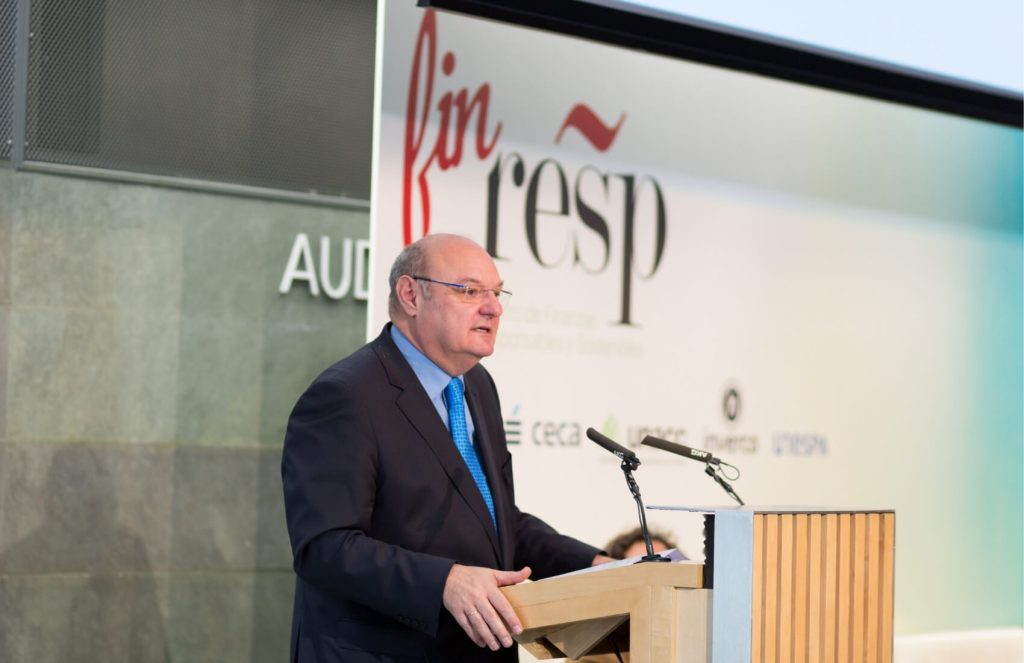
Good morning and thank you all for your attendance.
Today, we have reflected together on one of the major transformations currently occurring in the global financial industry: the growing interconnection between sustainability, economic activity, and financing. This is a structural change whose effects we are just beginning to glimpse.
This process of change has a global roadmap: the Sustainable Development Goals (SDGs), also known as the 2030 Agenda; and, regarding the climate aspect, the Paris Agreement (COP-21). The more or less global consensus around these goals is allowing us to accelerate the transformation towards sustainable coexistence models, in appropriate balance with the ecological and social environment.
The SDGs, especially those related to climate change, represent a paradigm shift in the model of economic growth. This transition will require an immense volume of investments:
– The United Nations Conference on Trade and Development estimates that annual investments of between $5 and $7 trillion are needed to achieve global objectives.
– According to calculations by the European Commission, the EU must address an annual investment deficit of nearly €180 billion to achieve its climate and energy goals by 2030. For the goal of decarbonizing the European economy by 2050, impact studies estimate that an average annual investment of €1.33 to €1.42 trillion will be required starting from 2031 through 2050.
– Domestically, the Integrated National Energy and Climate Plan estimates that nearly €250 billion is needed in Spain for the decade we have just begun, which is about 1.5% of GDP.
These figures perfectly illustrate the need for effective cooperation between the public and private sectors, ensuring the adequate channeling of capital flows towards the necessary investments for achieving sustainability objectives. This is where the financial sector intervenes, as the circulatory system of the business ecosystem.
The contribution of the financial sector should be articulated from at least three perspectives:
– Firstly, financing. The banking sector, represented here by AEB, UNACC, and CECA, is responsible for financing the investments related to achieving the SDGs, with the additional challenge of measuring social and environmental risks. The commitment of this sector in Spain to sustainability has been most prominent when more than 95% of its entities signed the Collective Agreement on Climate Change at the recent COP25.
– Secondly, insurance. Insurance companies are key to addressing the physical risks brought about by climate change. UNESPA, as the association of the insurance sector, has disseminated the United Nations Principles for Sustainable Insurance among its member entities to integrate environmental, social, and governance (ESG) issues into decision-making processes.
– Thirdly, asset management. The sector of collective investment institutions and pension funds, grouped under the INVERCO association, is key to channeling funds towards a more sustainable and decarbonized economy. They were pioneers when, in 2014, they published the circular “Application of Environmental, Social, and Corporate Governance Criteria in the Investment Policy of Collective Investment Institutions.”
In this context, FINRESP emerges as the result of shared reflection across the financial sector in its multiple manifestations. It is a milestone, and it is worth emphasizing today that these five institutions (AEB, CECA, INVERCO, UNACC, and UNESPA) have united in a common project around sustainable finance.
FINRESP aims to contribute to a more sustainable and responsible economic and financial activity by creating a meeting point, debate, awareness, and experimentation space for the stakeholders in the financial services industry. In particular, FINRESP intends to be a reference center for linking sustainability with the productive fabric, especially among the small and medium-sized enterprises of our country.
This vision is materialized in four strategic objectives that will guide FINRESP’s activities in the immediate future:
– Increase awareness among economic agents and Spanish society regarding the challenges and opportunities presented by the 2030 Agenda.
– Improve the capacities and skills of economic agents in fulfilling this agenda, primarily among SMEs.
– Support the identification of financial solutions conceived as best practices.
– Promote innovative formulas that link sustainability and financing.
A fifth aspect intended to characterize FINRESP is its international projection, as evidenced by our recent adherence to the Financial Centers for Sustainability forum promoted by the United Nations.
To achieve these objectives, we have developed a roadmap of joint actions to help accelerate the transition towards a sustainable and responsible economy. This roadmap was outlined in the institutional declaration published by FINRESP on the occasion of COP 25 in Madrid, where the following commitments were made:
– Promote sectoral actions aimed at contributing to the implementation of the global climate agreement established at the Paris Conference (COP21) and to achieving Sustainable Development Goals most closely linked to financial activity.
– Initiate dissemination actions regarding sustainable finance and climate change through seminars, debates, reflections, and practical proposals.
– Actively collaborate with public authorities in shaping and implementing an effective regulatory framework to achieve the goals of combating climate change.
– Promote the adherence of financial sector entities to the principles and standards for sustainability established by the United Nations, which foster the integration of environmental, social, and governance issues in decision-making; customer and supplier awareness in the field of sustainability; and public and periodic disclosure of progress under these principles.
– Prepare an annual report on the progress of sustainable finance in Spain.
It is important that we fully recognize the magnitude of the challenge we face as a sector. In the last two years, we have made significant progress as an industry: we have understood and accepted the role we are to play in this global effort. But now it is time to get to work. And we will face significant difficulties that I have no doubt we will overcome together, as we always have.
Authorities are setting a very demanding agenda. The Von der Leyen Commission has launched its Green Deal, which is turning the European Union into the primary international benchmark for legislation on sustainable finance. Indeed, the Union is rapidly advancing in regulating key aspects for the development of sustainable finance, such as transparency, identifying non-financial risks, increasing disclosure requirements, defining standards, and the necessary taxonomy that will define the concept of ‘sustainable investment.’
In this context, it is essential to highlight the growing involvement of European Supervisory Authorities, which have already initiated the debate on the connection between sustainability and prudential regulation. Identifying types of climate risks, their modeling, and their treatment for capital consumption are issues that will occupy us in the coming months.
We begin the year 2020, ushering in a decade that the Secretary-General of the United Nations (Antonio Guterres) has termed ‘The Decade of Action.’ An action dependent on the new needs of clients in an increasingly digital and unstable environment, fraught with regulatory challenges that direct the sector towards a more open and competitive model. And it is precisely this environment that should spur us to position ourselves at the forefront of sustainable finance.
I thank all of you, on behalf of the five sponsoring associations of FINRESP, for your attendance here today at this event, which I hope in a few years we will remember as a milestone that marked the beginning of a great project.
Next, one of the foremost experts in our country on sustainability and climate change, Valvanera Ulargui, will speak. She is currently the director of the Spanish Office of Climate Change, an institution under the Ministry for Ecological Transition and the Demographic Challenge. She has also advised significant institutions and organizations such as the European Commission and ICEX in high-level sessions regarding combatting climate change, like those that laid the groundwork for the Kyoto Protocol.
Valvanera, I would like to thank you for your presence here today for the closing of the event. The floor is yours.
Thank you very much.
Tu navegador envía la señal Global Privacy Control: «Aceptar todo» no activa Marketing cookies. Puedes activarlas aquí si lo deseas.
These cookies are essential for the website to function and cannot be disabled. They are generally set in response to actions you take, such as setting privacy preferences, logging in, or filling out forms.
They enable enhanced functionality and personalisation, such as videos, live chat, preferred language and region.
They allow us to count visits and traffic sources in order to measure and improve the performance of our site. They help us to know which pages are the most and least popular.
These cookies are used to show ads relevant to you and your interests. They are also used to limit the number of times an ad appears and to measure the effectiveness of advertising campaigns.