


READING MATERIALS OF INTEREST
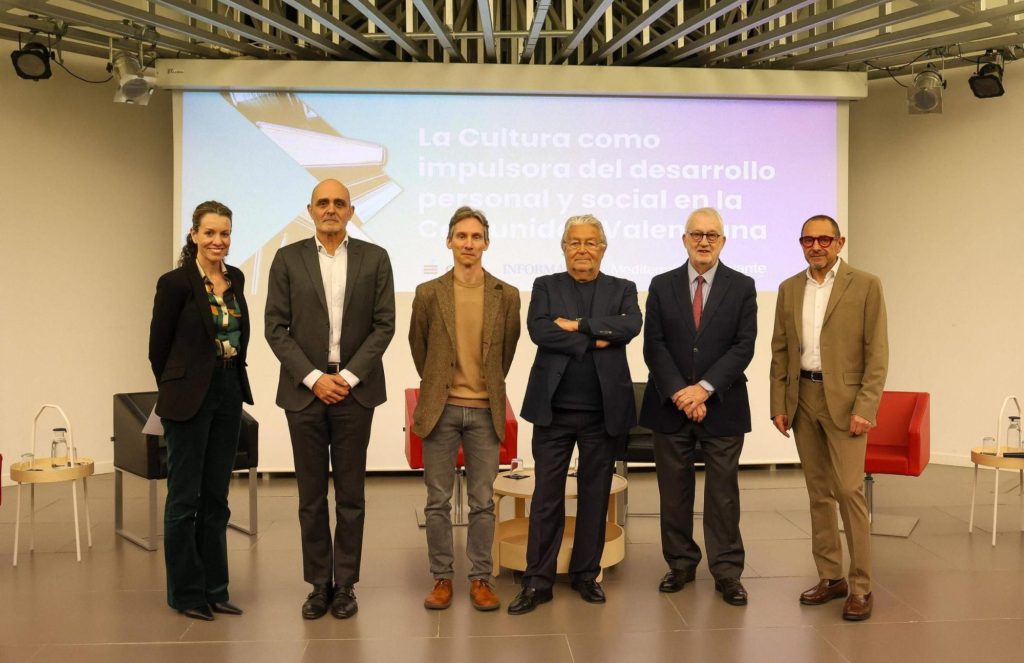
Culture is a key factor in social transformation. In 2019, the WHO marked a turning point by presenting a report that urges governments to incorporate arts and culture into the healthcare environment, considering them a healing element that, therefore, benefits our health. Caring for, promoting, and disseminating culture is a commitment that many entities have embraced as a mission, which is why Levante-EMV, along with CECA, Association of banks, savings banks, and foundations, organized the discussion “Culture as a driver of personal and social development in the Comunitat Valenciana” on Friday, February 23rd.
The meeting, moderated by Silvia Tomás, director of Institutional Relations at Prensa Ibérica in Valencia, featured participants such as Álvaro Borrás, director of CaixaForum Valencia; Roberto Sanz, head of the Obra Social de Caixa Ontinyent; Rafael Alcón, president of Fundación Bancaja; Luis Boyer, president of Fundación Mediterráneo; and Alberto Aza, spokesperson for CECA.
“Culture is an antidote against indoctrination by promoting critical thinking, against intolerance by fleeing from dogmatism in favor of a continuous search for truth, against misunderstanding, because it allows us to understand where we come from and where we are going, and against social exclusion,” stated Alberto Aza, spokesperson for CECA, when Silvia Tomás asked about the role of culture in social development, as Tomás asserted, “defining and developing attractive, sustainable, respectful, and inclusive cultural projects is more important for society than we can imagine.”
Álvaro Borrás, director of CaixaForum Valencia, declared that “culture is sufficiently important in itself.” “Any society that wants to develop needs culture. The more culture, the greater the development and vice versa.” For Borrás, culture is “a basic necessity”, “during the pandemic, when you no longer feared for your health, you feared boredom”.
For the president of Fundación Bancaja, Rafael Alcón, “culture and social action are part of our DNA; without culture, people do not progress, it is completely necessary.” Likewise, Alcón perceives that “there is no awareness of the necessity of culture.”
On his part, the president of Fundación Mediterráneo, Luis Boyer, spoke about the role of culture as a formative agent: “we are in a technological advance that absorbs a lot of time, especially from the youth, and things that do contribute, such as culture and education, are lost, which help transcend everyday life.” “On social networks, reasoning does not occur; one adopts the stance of hooligans. Culture breaks this and consolidates the democratic system,” Boyer added.
The head of the Obra Social de Caixa Ontinyent, Roberto Sanz, stated that “culture is social action.” “Activities or university training contribute to personal or social development, allowing advancement and creating opportunities in the working world in which to develop interests.”
Obra Social
“The mission of the Obra Social is to promote the social progress of people, fighting against exclusion,” defined the spokesperson for CECA. “The Obra Social is carried out through six lines of action: social action to address the needs of the most vulnerable groups; support for education and research; promotion of culture; local development; promotion of sport as a vehicle for values such as effort or solidarity; and the environment and sustainability,” stated Aza.
Cultural Heritage
Another fundamental aspect of the Obra Social is the conservation and dissemination of cultural heritage. Fundación Bancaja carries out this work with the works of Joaquín Sorolla. “We have always been a reference for Sorolla. We have inherited and maintained this legacy through hard work.” Through numerous exhibitions such as “Sorolla through light” or “Sorolla in black,” Valencian society and tourists who approach the capital of Turia can learn about the creation of the quintessential Valencian painter.
Fundación Mediterráneo is the custodian and depositary of a valuable artistic legacy. Its statutes include the obligation to preserve and disseminate this heritage. “From Fundación Mediterráneo, we acquired a whole legacy from notable individuals and dedicated a significant amount of economic resources to digitize it so that this cultural archive is accessible to all,” expressed its president, Luis Boyer. Additionally, the Foundation brings together three major artistic centers: the Modernist House Museum, the Azorín House Museum, and the Centro de Alcoi. “Before the pandemic, Azorín’s family donated more than two thousand original documents to us, from photographs to cinema cards and an unpublished book.” With all this, they are creating the traveling exhibition “Azorín’s suitcase.”
Fundación “la Caixa”‘s commitment to culture materializes with the creation of CaixaForum. “In just over a year, we have had more than a million visitors,” stated Álvaro Borrás, director of CaixaForum Valencia. “The achievement of CaixaForum is to be able to offer a meeting space between knowledge and people, for all audiences and without hierarchies,” he stated. He also attributes the museum’s success to public-private collaboration, “between the public and the private lies the common.”
Caixa Ontinyent has its own cultural center in the historic center of the municipality, whose goal is to “host activities of different nature such as exhibitions, conferences, talks, screenings, concerts, training courses, days, conventions, meetings, and workshops, organized both by Caixa Ontinyent and by other groups,” said the head of the Obra Social, Roberto Sanz. “The center is an open space for the entire population to participate, so citizens can attend a book presentation or request the space to hold a neighbors’ meeting. We wanted an open place where everyone could develop their interests,” Sanz commented.
Alliances
CECA is an example of the advantages of uniting efforts between entities. “Collaborating and cooperating is always a good way to achieve common goals,” stated its spokesperson Alberto Aza. “As an association, an important part is to establish that framework of work, those meeting points. During the pandemic, it was thanks to that collaboration between banking entities and foundations that we were able to implement socially significant plans. As members of the United Nations Global Compact, we have a commitment to the SDGs, and the 17th speaks of these alliances to achieve common goals.”
“In the cultural sphere, we have launched a working group with the aim of working on how entities can cooperate more in the field of culture, how to capitalize on exhibitions or how to work together on this significant project of digitizing heritage. Collaborating as much as possible while always respecting the particularities of each entity,” added the spokesperson for CECA.
Education and Awareness
Regarding the educative function of culture, Rafael Alcón, president of Fundación Bancaja, highlights the ‘D-Capacity Week’, “a social awareness initiative developed each year around the International Day of Persons with Disabilities on December 3, aimed at raising awareness of the need to advance in the integration of this group.” In addition, the foundation conducts training in educational centers throughout the year, working on the exhibitions that they carry out.
“Culture is training and enjoyment, but also a guarantee for the democratic system,” reinforced Luis Boyer, president of Fundación Mediterráneo, in his closing message. “There is a component of democratic social training that, if it disappears, would be a catastrophe.”
“We have evolved with society. We have been able to create resources, digitize ourselves, and implement sustainability. Our proximity to the environment has allowed us and enables us to do these things,” concluded Roberto Sanz from Caixa Ontinyent.
On his part, Álvaro Borrás, director of CaixaForum Valencia, ended his participation by stating that “culture is the generation of critical spirit and reflection. We believe in culture and we grow with culture.”
“The world cannot be conceived without culture; without music, without theater, without literature, without art. Only chaos,” concluded Alberto Aza.
These cookies are essential for the website to function and cannot be disabled. They are generally set in response to actions made by you, such as setting your privacy preferences, logging in or filling in forms.
They enable enhanced functionality and personalisation, such as videos, live chat, preferred language and region.
They allow us to count visits and traffic sources in order to measure and improve the performance of our site. They help us to know which pages are the most and least popular.