

READING MATERIALS OF INTEREST
The rise of digital banking has led users to enhance their security to the maximum with habits such as changing passwords regularly, avoiding public networks for transactions, or not sharing personal access data with third parties.
Digital banking in Spain has seen significant growth in recent years, as a result of substantial investments made by the sector in innovation and the digitalization of financial products and services. Today, 50% of bank customers are already digital, and in some institutions, this percentage rises to 70%. Undoubtedly, the ability to access digital financial services offers significant advantages for users: speed, accessibility, and convenience, among others. But at the same time, potential risks arise that compel entities and users to reinforce security measures to the utmost.
Internet traffic has grown globally over the last two years due to an increase in many digital activities. Many companies have been forced to accelerate their digital transformation. The shift towards telecommuting and remote education has surged the demand for cloud services and connectivity, accelerating the digital economy and the growth of online traffic. Additionally, the number of users with Internet access has increased worldwide, and more than half of the global population now uses mobile Internet.
Financial entities are betting on technology as a means to protect both their clients’ data and their bank accounts. In this sense, in addition to the classic recommendation to choose secure passwords and change them regularly, they are also implementing new security methods and working to facilitate easier access through their digital applications.
Furthermore, the European directive PSD2 has strengthened the security of electronic authentication systems. This ensures that any payment is executed with enhanced verification of the user’s identity.
Entities associated with CECA (CaixaBank, Kutxabank, Cajasur Banco, Abanca, Unicaja Banco, Ibercaja Banco, Caixa Ontinyent, Colonya Pollença, and Cecabank) have gathered the following advice to protect your finances online.
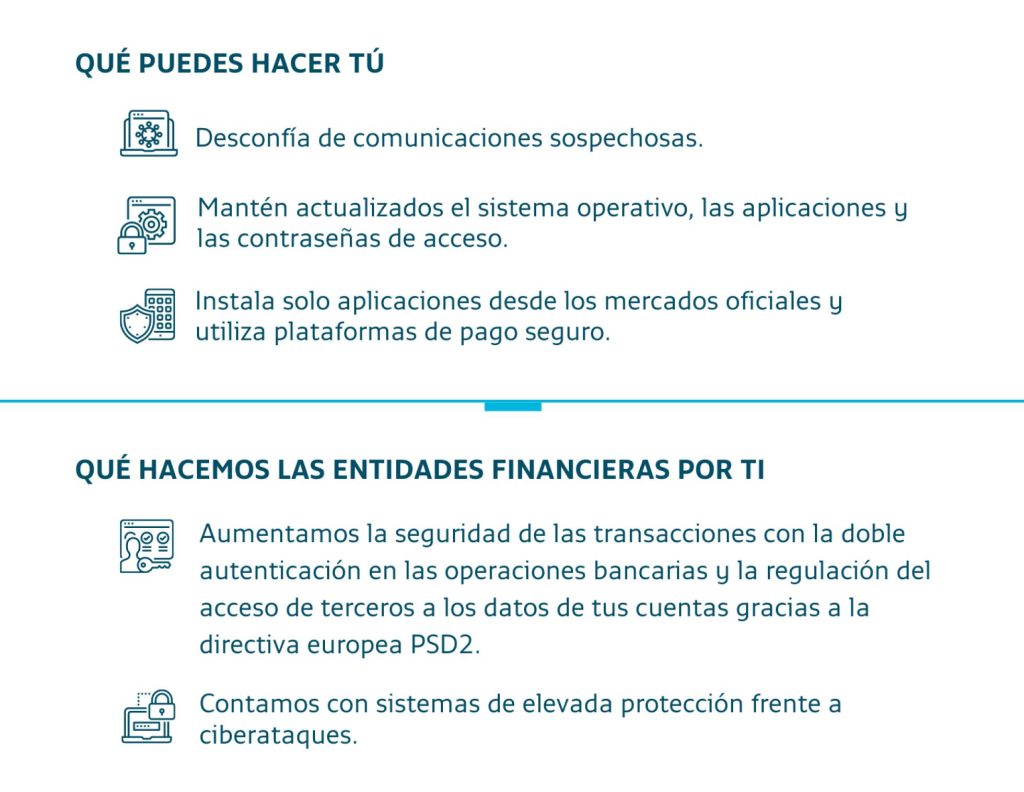
In addition to the security applications implemented by financial entities, clients are also advised to take particular precautions to prevent security breaches. In this regard, it is recommended to not share mobile banking access passwords, nor the access code or pattern for devices (smartphones, tablets, or computers). Moreover, it is suggested to configure the automatic lock option on mobile devices. This can be achieved through PIN, unlock pattern, fingerprint, or facial recognition tools if the mobile device has such capabilities.
Users should also avoid entering private information on public wifi networks, as some of these open networks can be used to spy on data traffic. This way, users, passwords, and other information can be captured and misused fraudulently.
Regarding passwords, it is requested to change them regularly and use combinations that entail some difficulty. These should not be saved on mobile devices or computers. Account numbers or debit or credit card numbers should also not be stored, as these are confidential data. If devices are stolen, the criminal would obtain sensitive information from personal equipment.
To reinforce security, personal or financial information should not be provided via calls, messages, or emails. Lastly, any suspicious activity should be reported to the bank immediately. There are many factors influencing banking security. Fortunately, with the help of technology, entities are taking steps to strengthen and protect their clients’ data security.
For more information, visit Our Secure Data, and if you wish to stay updated with security tips, follow their profiles on Twitter, Facebook, and LinkedIn.
These cookies are essential for the website to function and cannot be disabled. They are generally set in response to actions made by you, such as setting your privacy preferences, logging in or filling in forms.
They enable enhanced functionality and personalisation, such as videos, live chat, preferred language and region.
They allow us to count visits and traffic sources in order to measure and improve the performance of our site. They help us to know which pages are the most and least popular.