

READING MATERIALS OF INTEREST
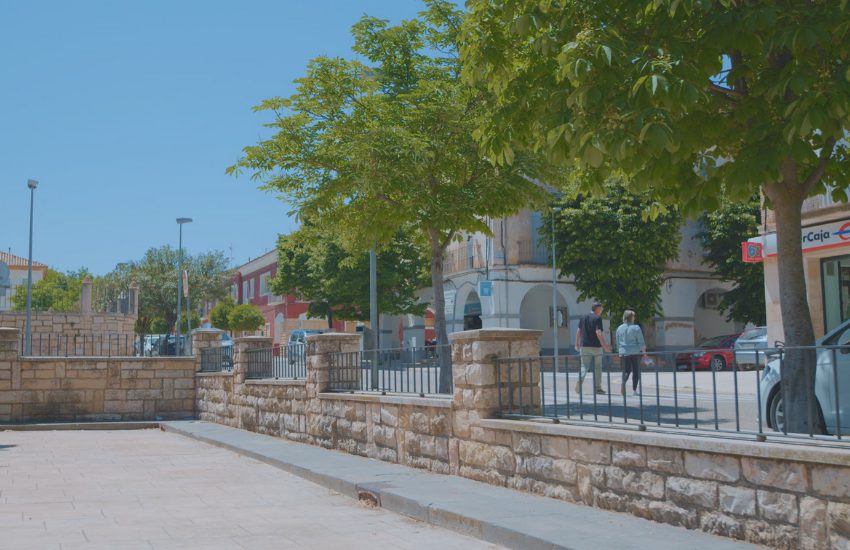
Belchite has a grocery store where food is sold and money is given. It’s not a gift; rather, thanks to cashback, a business can act as an ATM, representing another avenue banks are pursuing to ensure cash access in rural areas of Spain.
In Belchite, the Old Town, which you may recognize from the namesake battle that destroyed it during the Civil War, there are no longer any residents. The last one left in the 1960s. But in the new town, there are. As many as 1,540, according to the latest data from the National Statistics Institute.
Belchite is Belchite, located in Zaragoza; but it could be any town in rural Spain, with accents from Aragón, Castilla y León, Extremadura, or La Rioja, where the population is declining or not increasing, yet the average age is rising, with all the consequences that entails.
Basic services are decreasing with the fall in the number of inhabitants, and the difficulty in accessing them increases with each passing year for the residents of those localities. Not being particularly proficient with technology and an excessive reliance on cars that are no longer safe to drive do not help. Access to cash, which is taken for granted in urban areas, is one of the services affected by the closing of bank branches.
They say necessity sharpens ingenuity, and that’s what has happened with CECA’s banks and savings banks (CaixaBank, Kutxabank, Cajasur Banco, Abanca, Unicaja Banco, Ibercaja Banco, Caixa Ontinyent, Colonya Pollença, and Cecabank), which, aware of the importance of financial inclusion for economic growth and development, have sought innovative formulas to maintain their presence in rural areas.
“Cash remains the primary means of payment, and thus, institutions are implementing innovative solutions to continue ensuring access to cash, especially in areas with fewer branches,” explains Alberto Aza, CECA’s spokesperson.
This is how the bus-based Ofibus service of CECA’s associated entities was born, mobile branches that travel by bus to rural municipalities, allowing residents to perform cash withdrawals, deposits, and tax payments. Currently, this service has 20 Ofibuses in Spain that serve a population of 440,000 people spread across almost 500 municipalities.
Close proximity, human interaction, and a commitment to the territories of empty Spain where financial institutions want to continue being present by leveraging originality and innovative solutions. This is done using traditional channels that inspire confidence, especially among older populations.
“One of these solutions is the cash service that institutions offer to customers at Postal offices as an alternative to ATMs,” Aza notes. He refers to Correos Cash, an initiative that allows users to withdraw cash from offices or receive home deliveries. Using it is as simple as requesting a cash withdrawal via the bank’s app. Subsequently, the institution will take care of the procedures to request immediate remittance for collection at Correos or immediate delivery at home. Once the shipment is prepared, the postal carrier will deliver the cash and a receipt for the transaction to the customer at home.
Currently, Correos has 4,675 citizen service points (2,393 offices and 2,282 rural service points), and its postal carriers can deliver cash to any home in Spain. The initiatives continue as CECA institutions present further options. “The other method ensuring access to cash is the cashback solution,” Aza points out.
Just ten minutes from the town is another with significant historical importance and the birthplace of the universal Spanish painter Francisco de Goya, Fuendetodos. Another place where residents can access cash thanks to these banking solutions. An example of this is found in Montse’s grocery store, where requests for special cuts of meat (the famous ternasco and, of course, sausages), fruits, or cheese wedges alternate with requests for cash to take away. This is, indeed, what is known as cashback, utilizing a commercial establishment to withdraw cash.
Thanks to this system, already in operation in countries such as the United Kingdom or the United States, customers can pay by card for an amount exceeding their purchase, receiving the difference in cash. The cashback initiative is implemented in collaboration with all types of businesses, representing a wide range of possibilities for advancing financial inclusion in the so-called empty Spain. Moreover, it offers flexibility and freedom nearly equivalent to that provided by an ATM. It is clear that “with these solutions, the sector once again demonstrates its strong commitment to ensuring access to financial services, especially in rural environments.”
These cookies are essential for the website to function and cannot be disabled. They are generally set in response to actions made by you, such as setting your privacy preferences, logging in or filling in forms.
They enable enhanced functionality and personalisation, such as videos, live chat, preferred language and region.
They allow us to count visits and traffic sources in order to measure and improve the performance of our site. They help us to know which pages are the most and least popular.