



READING MATERIALS OF INTEREST
The financial sector plays a fundamental role in society, among other things, due to its capacity to safeguard the savings of families and businesses, manage their financial operations and investments, and protect individuals and their material assets through insurance. In Spain, last year, its activity accounted for more than 5% of the Spanish economy in terms of Gross Value Added and employed over 200,000 people.
Its contribution to the national economy was reflected in the management of financial assets worth 5.2 trillion euros in 2023, an amount greater than the GDP of countries like Germany, India, or Japan, and it managed over 4 trillion euros of families, companies, organizations, and Spanish institutions in different savings and investment instruments. This figure would be equivalent to 1.5 times the financial wealth of Spanish families at the end of 2023.
Moreover, the financial sector contributed to the transformation of the Spanish economy towards a more sustainable and digitized model, as well as to the social cohesion and development of the country. Thus, in 2023, banking was responsible for one in four euros issued in green, social, and sustainable bonds in Spain. Insurance, for its part, protected individuals, families, and businesses against nearly 3,600 daily claims caused by climate events, and sustainable investment and pension plans increased their assets to 162,065, a 23% increase compared to the end of 2022.
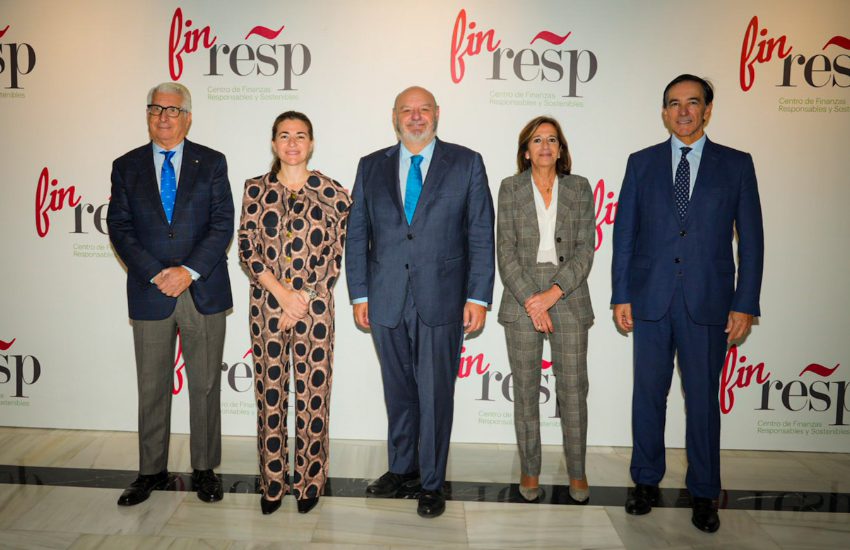
These are some of the conclusions and data derived from the Social Report of the Financial Sector 2023, presented by FINRESP, the Center for Responsible and Sustainable Finance in Spain, along with its founding organizations – AEB, CECA, INVERCO, Unacc, and UNESPA – which represent around 500 entities in the financial sector. FINRESP presented the document at an event held in Madrid, where José María Méndez, president of the organization, delivered an opening address in which he mentioned the catastrophe suffered due to the DANA in the eastern peninsula and especially in the Valencian Community, lamenting the loss of human lives and expressing the financial sector’s willingness to collaborate in supporting the affected communities.
During his speech, Méndez emphasized that “from the financial sector, we wish to join the enormous displays of national and international solidarity we have observed in recent days in the face of these devastating events. Our entities are carrying out valuable solidarity initiatives, and we are collaborating with the authorities in implementing regulatory measures to mitigate the impact of the DANA on families and SMEs. After a long night of work, today a Royal Decree-Law that supports the initiatives of banking associations in the field of moratoria, guarantees, and extensions of the Code of Good Practices is being approved. I would also like to highlight the rapid response from the insurance sector and the role of the Insurance Compensation Consortium, which are working tirelessly to address the damages and enable the affected communities to recover as soon as possible from this painful situation.”
The event also featured a round table discussion titled “The role of investment, financing, and insurance in the sustainable and just transition,” moderated by Pedro Guerrero, counselor of Economic and Financial Affairs at Spain’s Permanent Representation to the EU, which addressed topics such as the adoption of different ESG action lines by companies and institutions as well as their alliances. The panel included Ana Sainz, general director of Fundación SERES, who pointed out that “regulation concerning sustainability has increased in recent years, with greater demands in the financial sector. The key will be managing data to achieve a positive impact”. Meanwhile, Luis Martí, vice president of the Spanish Group for Green Growth and director of Public Policy and Regulation at ACCIONA, highlighted that “the energy transition is seen as a cost and not as an opportunity for companies. The goal is to help them integrate sustainability into their strategies”.
Jerusalem Hernández, partner of Sustainability and Good Governance at KPMG Spain, presented the main conclusions of the report, detailing the advances and challenges the industry faces in terms of sustainability and social responsibility.
Value creation from the activity itself
Among the magnitudes detailed in the Social Report of the Financial Sector 2023 is the granting of 450.985 billion euros in new financing for households and businesses in 2023, equivalent to three times the allocation for Spain from the European Union’s Recovery and Resilience Mechanism (MRR). Of this amount, 56.242 billion euros were allocated to housing. In Spain, more than 380,000 mortgages were formalized last year, accounting for nearly 60% of total housing purchase transactions.
The insurance sector’s role in protecting families, businesses, and institutions during the past year is also highlighted. In total, the insurance industry in Spain handled around 193 million claims in which it provided its services, averaging 528,767 incidents per day and amounting to 54.490 billion euros disbursed in 2023, a 10% increase from 2022. Additionally, more than 101 million insurance contracts were formalized in Spain, with the total insured capitals from all active insurance policies in the country being equivalent to ten times Spain’s gross domestic product (GDP).
The investment management sector demonstrated solid evolution in 2023, reaching 630 billion euros (an 11% increase from 2022) in assets managed through investment funds, with 23 million participatory accounts. Similarly, pension plans totaled 122.4 billion euros, reflecting a 6% increase compared to the previous year. Combined, these figures account for half of Spain’s GDP.
Regarding job creation, the sector employed over 202,000 people at the end of 2023, of whom 94% had indefinite contracts. This rate is 10 points above the national average. The commitment to diversity and equality within financial entities also continued to expand, with 52.8% of female employees compared to the national average of 46.7%. Furthermore, women currently occupy 26% of positions on governing bodies, reflecting a progressive increase in their presence in executive roles from 21% in 2021.
Education, financial inclusion, and support for rural areas
The financial sector continued to consolidate in 2023 as a pillar of social cohesion and territorial structuring in Spain, especially in rural areas and among the most vulnerable groups. Thanks to various financial inclusion measures, the population without access to banking services in their municipality was reduced by 12.7% in 2023.
As a result, of the 8,131 municipalities in Spain, two out of three already have some point of physical access to banking services (5,456 municipalities where 99.1% of the population resides). In Spain, the ratio of inhabitants per bank office is 2,657, making it the country with the third densest network in the euro area, following Bulgaria and France.
Similarly, the insurance industry continued to promote the economy and protection in rural areas through its network of over 680,000 collaborators and service providers; in addition to more than 74,000 points of attention for insured individuals. As a result, Spain already has 16.1 points of insurance assistance for every 10,000 inhabitants.
Regarding financial education, in 2023 financial entities and their associations carried out over 12,900 training and awareness-raising activities within the framework of 481 projects, training 3.5 million people. These initiatives aim to provide various groups with key knowledge in finance and digital skills, contributing to inclusion and informed decision-making.
Commitment to green, social, and sustainable finance
In the realm of sustainable finance, Spain issued a total of 29 sustainability-linked bonds worth 16,399 million euros in 2023. By volume, 26% was issued by financial sector entities. Likewise, the granting of sustainable wholesale loans reached 39,322 million euros, doubling the green financing granted by the Official Credit Institute (ICO) under the Government of Spain’s Recovery Plan.
On the other hand, the sector made a significant contribution to mitigating the impact of climate change. In 2023, insurers paid out 2,419 million euros to cover over 1.3 million climate-related claims (3,596 per day), highlighting the sector’s role in protection against environmental risks and its importance in providing coverage to sectors highly exposed to these phenomena, such as agriculture.
In terms of investments, the assets managed sustainably or with sustainable criteria stood at 118.276 billion euros in investment funds at the end of 2023 (a 13% increase compared to 2022) and 43.789 billion euros in pension plans (50% more). More than 11.5 million saver accounts in pension plans and participants in investment funds channeled their investments and savings with sustainability criteria in the past year.
These cookies are essential for the website to function and cannot be disabled. They are generally set in response to actions made by you, such as setting your privacy preferences, logging in or filling in forms.
They enable enhanced functionality and personalisation, such as videos, live chat, preferred language and region.
They allow us to count visits and traffic sources in order to measure and improve the performance of our site. They help us to know which pages are the most and least popular.