


READING MATERIALS OF INTEREST
The challenges and issues facing the Social Work promoted by the Foundations include mental health, the digital divide, and new forms of poverty.
Education and internationalization among its priorities.
With an investment that reached €851 million in the last year, but totals €7.823 billion in the last decade —according to data accumulated since 2014—, the CECA sector is consolidated as the leading private social investor in Spain. The Social Work promoted by the entities associated with CECA (the association representing CaixaBank, Kutxabank and Cajasur Banco, Abanca, Unicaja, Ibercaja Banco, Caixa Ontinyent, Colonya Pollença, Cecabank, and more than thirty foundations) carried out nearly 81,000 activities that reached over 30 million beneficiaries with that funding during 2023.
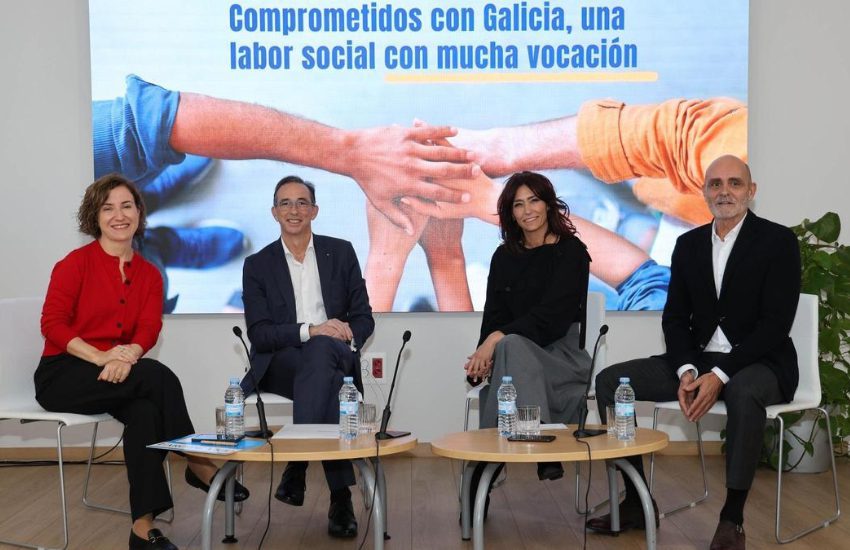
These figures reflect the lever for social development, especially for vulnerable groups, that the Social Work promotes, as explained by CECA’s spokesperson, Alberto Aza, at the forum “Committed to Galicia, a social work with great vocation,” organized by Prensa Ibérica with the three publications of the group in Galicia: FARO DE VIGO, La Opinión de A Coruña, and El Correo Gallego this week.
The deputy editor of the newspaper, Irene Bascoy, moderated the debate which also included the territorial delegate of the “la Caixa” Foundation in Galicia, Susan Santos, and the managing director of Afundación, Pedro Otero. She focused from the first question on the importance of the sector: “In March 2022, the president of the Economic and Social Council (CES), the Vigo native Antón Costas, stated that the Social Work of the CECA sector is the second pillar of the welfare state in Spain,” she pointed out. Aza took on the challenge and defended that it is “an indispensable complement, a pillar for the promotion and support of civil society initiatives in favor of the most vulnerable groups in our society.” Looking back through history, he recalled “a Social Work whose historical trajectory dates back over three centuries, with the emergence of the first montes de piedad, formalizing its purpose with the appearance of savings banks in the early 19th century.” In a banking context governed by numbers and exact values, Social Work gives back the account to society.
For her part, Susan Santos explained that studies carried out by the “la Caixa” Foundation have allowed for focusing its programs to address poverty from a comprehensive perspective, adapting to the multifactorial nature of this problem. This foundation constantly evaluates and measures the impact in the context and the territory, adjusting the programs as needs change, revealed the official. An emerging phenomenon is the “multivulnerability,” which expands “fragility” across all ages: lonely and vulnerable elderly people, adults with difficulties accessing employment, and children in situations of inequality or poverty. Thus, “social work adapts to new forms of poverty, designing interventions that respond to this growing complexity,” indicated the expert.
In his turn to speak, Pedro Otero explained that Afundación, the Social Work of Abanca, celebrates its tenth anniversary by consolidating itself as the main vehicle of social responsibility for the bank in Galicia. Its focus centers on three strategic lines: support for the elderly, promotion of culture, and strengthening of education. In the area of elderly care, Afundación addresses the challenges of longevity by listening to people, working on active aging, and researching to adapt programs to their needs. “Afundación operates in eleven centers for elderly people in Galicia, with 15,000 members and 30,000 annual participations,” he detailed. In the cultural area, the Social Work of Abanca manages 78,000 m² in infrastructures and a significant art collection, impacting the seven main cities in Galicia. “In each area, whether through exhibitions, intergenerational programs, or value education proposals,” it seeks to empower participants and promote their development, occupying a significant part of the budget in Galicia.
Challenges and future
During the meeting, not only the history and present work were addressed, but also the challenges and future perspectives of social work. In an environment where the commitment of foundations is increasingly important, the success of Social Work depends on a genuine closeness to beneficiaries, allowing for understanding and addressing their needs in an individualized manner. It also requires anticipating —even— public administrations.
The digital divide stands out as one of the main current challenges. On the other hand, CECA promotes collaboration and the exchange of experiences internationally through the World Institute of Savings Banks and Retail Banks, presided over by Isidro Fainé. This organization has constituted a Social and Philanthropic Council that seeks to visualize and share best practices from the more than 6,000 entities it represents. The goal of this global network is to learn from experiences in each country and explore synergy and cooperation opportunities to create joint programs with greater reach, indicated Alberto Aza.
“The future of Social Work must continue to develop along the same current line, focusing on the detection and analysis of new forms of poverty, especially in collaboration with third sector entities. It is crucial to closely study vulnerable environments and anticipate challenges, such as the digital divide, mental health, unwanted loneliness, and inequality in access to employment,” defended Susan Santos. Meanwhile, Pedro Otero reflected on a lesson from the recent past: “The pandemic, which forced many foundations to adapt quickly, demonstrated the importance of flexibility and the ability to respond to new needs.” He also did not shy away from the importance of actively aging and addressing mental health, both in the elderly and in young people, as crucial areas to continue working on. Regarding population dispersion and attention to rural areas, Afundación promotes solutions to offer the same quality of service in all areas.
Exporting knowledge
Finally, it was noted that with globalization and multiculturalism increasingly present in communities, social entities must learn and also export knowledge. As a demonstration of their adaptation, he cited the retirement clubs, “where the elderly would gather to play cards, but later evolved into centers with leisure services, training, and professional care such as podiatry and psychology.” Nowadays, we call them “spaces +60” and they not only provide services but also harness the experience of the elderly, promoting volunteering and companionship.
“Now I feel part of something”
Afundación and the “la Caixa” Foundation value the return of their projects: from theater to make TEA visible to the resilience of migrants.
The emotional letter from a mother wanting to express the impact that a play about bullying in Vigo had on her son, a child with autism spectrum disorder (TEA) surprised the Afundación team. “She told us what her son said after seeing the play ‘Hugo’: Mom, finally I have seen that I am not alone, that there are people like me. I am happy because this helps me keep going.” “That phrase still moves me,” confessed the head of Afundación, who at that moment realized that the value of their work transcends great projects. “When you see that you manage to connect in such an intimate way with someone, you understand why we are here,” reflects the executive.
They spoke of a play that was performed in various locations in Galicia and left a mark on the audience. “The theater was full, with more than 400 children watching it,” says the organizer. But the true test of the impact achieved came shortly after, on social media, which filled with messages from families whose children attended and shared their impressions at home. “It is difficult to measure success, but if the children come home and convey the message, you know you touched an important chord.”
Another example of success is the “CaixaProinfancia” program, from the “la Caixa” Foundation, which focuses on breaking the intergenerational transmission of poverty and promoting comprehensive socio-educational development for children aged 0 to 18 in Galicia. This is the case of a Venezuelan family settled in Vigo whose oldest daughter faced barriers to integrating into the educational environment but managed to finish her high school studies and is now pursuing a higher vocational training module. Her brother is successfully advancing in secondary school, and her mother is receiving support to find employment and regularize her situation. “Now I feel part of something after believing I was part of nothing,” the young girl stated in one of the documentaries of the “Told Lives” project of the “la Caixa” Foundation. Since its implementation in 2016 in the 7 main cities of Galicia and in collaboration with 28 third-sector entities, “CaixaProinfancia” has provided support to 1,500 minors and 900 families, focused on personalized integral attention and offering everything from school reinforcement to psychological support, speech therapy, or leisure activities.
For years, the Social Work of the CECA sector has become a fundamental tool for fighting inequality, social exclusion, and the risk of poverty, “demonstrating its essential role as a structural element of society,” according to Alberto Aza. “Social Work is an essential complement to the welfare state, as it offers agility, proximity, and a capacity for adaptation that public policies, due to their budgetary and political rigidity, often cannot achieve,” reasoned the spokesperson during the forum “Committed to Galicia,” in Vigo.
The CECA sector carries out its charitable and social activities in various areas, aiming to cover all population segments and “allowing for a personalized approach and a quick response to needs, as evidenced during the pandemic.”
“We must continue to maintain the capability for listening in Galicia” – he assured – “which is becoming increasingly larger and multicultural.”
“The future of Social Work is projected as an intense challenge, but with a focus on cooperation,” summarized Alberto Aza.
And at the end of the forum, the importance of public-private collaboration came up, “as it allows for synergies to be added and responds flexibly to societal needs, adjusting its programs thanks to continuous evaluation, optimizing resources and avoiding duplications.” That is, adapting or anticipating reality to act upon it, concluded the spokesperson.
The “la Caixa” Foundation promotes social progress through various programs that have transformative power and lasting impact, accompanying people in all stages of the life cycle. In this way, people in situations of vulnerability can develop their potential, capacities, and talent. Among its initiatives, CaixaProinfancia stands out, a program whose main challenge is to promote socio-educational actions to foster the development of children and their families, with the goal of generating future opportunities and breaking the hereditary cycle of poverty. This program is characterized by its leadership, networking, and territorial reach, focused on reducing inequality. “We develop programs with a high power of social transformation,” expresses the territorial delegate in Galicia, Susan Santos. The programs of the “la Caixa” Foundation are backed by scientific directions, experts, and there is a study of social needs behind them, she assures.
In her debate at the forum “Committed to Galicia,” the expert in Social Work specified that poverty no longer only affects those who are unemployed but also older people —or young people— who, despite having pensions, do not manage to meet their basic needs. “To face these challenges, it is essential to promote collaborative philanthropy. This approach not only creates immediate impact but also allows for the establishment of transferable working models,” she highlighted. Regarding work parallel to that of public administrations, Santos stressed “the importance of public-private collaboration that foundations can play: to be more than complementary and build together.
Afundación has developed a broad educational infrastructure in Galicia, which includes vocational training centers and nurseries to an innovative university. Education in values is one of its pillars, reaching nearly 690 educational centers in Galicia and benefiting annually over 120,000 students aged 5 to 16. In addition, since 2017, it has promoted a financial education program that reaches more than 200,000 children annually. “Education has an absolutely transversal presence in all the programs we create; we never consider launching a program without looking at the different educational aspects we can address,” asserts Pedro Otero. “Education is understood comprehensively, promoting skills that help overcome situations of vulnerability.” Their innovative university stands out for a unique model that is also present throughout the entity’s educational action, which researches, designs, and implements projects to contribute to transformation.
These cookies are essential for the website to function and cannot be disabled. They are generally set in response to actions made by you, such as setting your privacy preferences, logging in or filling in forms.
They enable enhanced functionality and personalisation, such as videos, live chat, preferred language and region.
They allow us to count visits and traffic sources in order to measure and improve the performance of our site. They help us to know which pages are the most and least popular.