



READING MATERIALS OF INTEREST
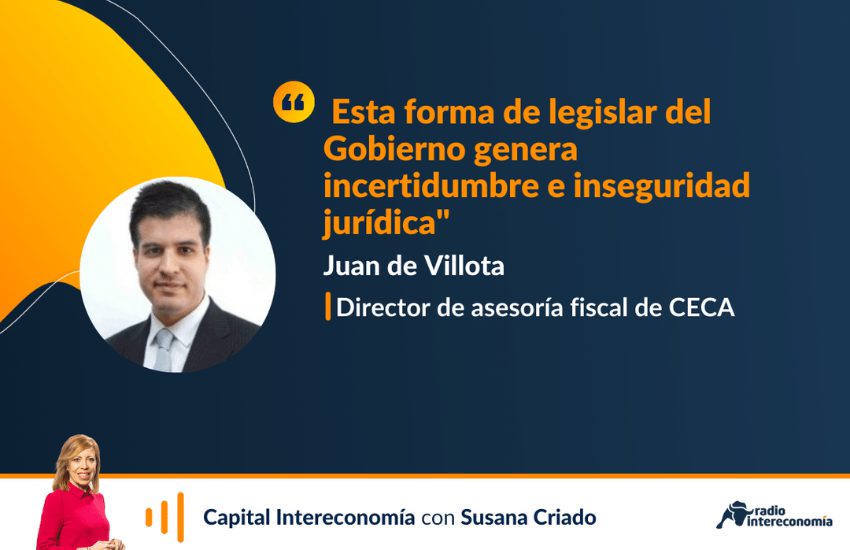
Juan de Villota, director of tax advisory at CECA, has addressed issues related to the banking tax on the program ‘Capital Intereconomía’ of Radio Intereconomía.
The full Congress is debating today the Government’s tax reform. It is a package of measures upon which the fifth disbursement of European funds depends, and so far, it does not have guaranteed support to move forward as Podemos wants the Government to commit to approving the tax on energy companies.
Will the tax on multinationals be applied?
At stake is the minimum tax of 15% on large multinational companies and a series of amendments that will be voted separately, such as the taxes on diesel and on short-term rentals, the elimination of the tax regime for socimis, and the banking tax.
Juan de Villota has explained in Intereconomía the legislative process of the Government expressing his concern about the lack of clarity regarding the support that the reform could gather: “As of today, we do not know what the votes or formed majorities are. There is a real risk that it may not go ahead. We also do not know what the concrete impacts will be.”
Is the banking tax fair?
Regarding the banking tax, Villota believes it is not justified, especially in the current context of decreasing interest rates: “We are in a situation where rates have fallen by 0.75 and could drop even further next year, even below 2%. With an uncertain political landscape, the tax reform faces a key debate that will determine its viability and economic implications for the country.
These cookies are essential for the website to function and cannot be disabled. They are generally set in response to actions made by you, such as setting your privacy preferences, logging in or filling in forms.
They enable enhanced functionality and personalisation, such as videos, live chat, preferred language and region.
They allow us to count visits and traffic sources in order to measure and improve the performance of our site. They help us to know which pages are the most and least popular.