


READING MATERIALS OF INTEREST
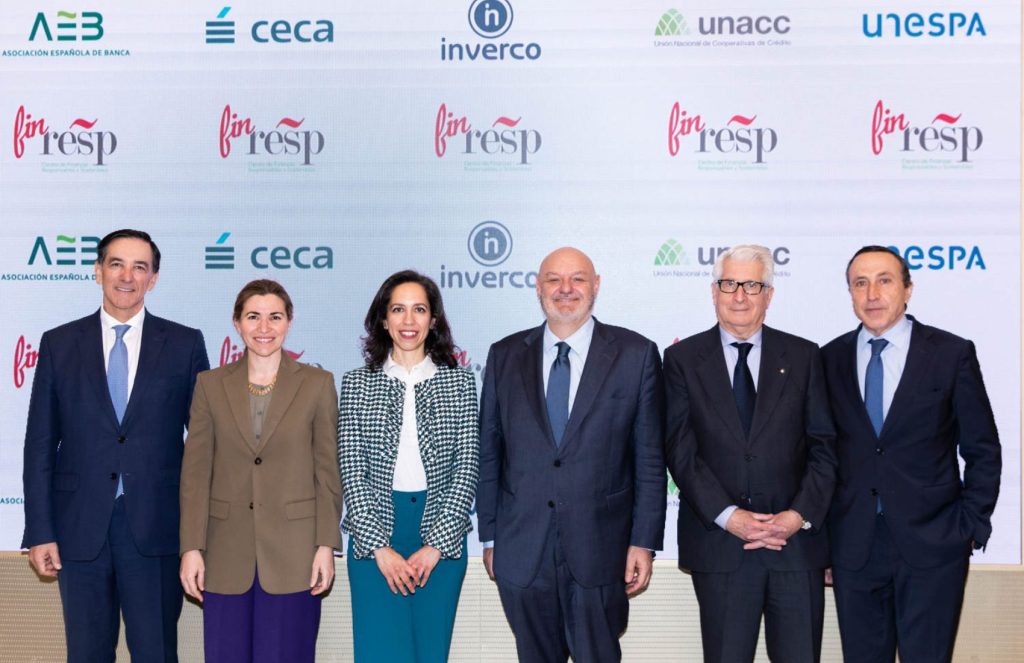
The V Annual Meeting of Finresp brought together representatives from financial entities, lawmakers, regulators, and experts to discuss the current landscape of sustainable finance.
During the event, discussions centered on the role of European regulation and the convergence between decarbonization and competitiveness in companies. There was also emphasis on the importance of reinforcing mechanisms against climate risk and the need to improve prevention and awareness.
The meeting featured participation from José Manuel Campa, President of the EBA; Paloma Marín, Vice President of the CNMV; Manuel Illueca, President of the ICO; Ana Puente, Deputy Director of Sustainable and Digital Finance at the Ministry of Economy; Juan Carlos Delrieu, Director of the ASG Office at the Banco de España; Mª Àngels Ramón-Llin, General Director of Agricultural and Livestock Production of the Generalitat Valenciana; Gonzalo Gortázar, CEO of CaixaBank; César González-Bueno, CEO of Banco Sabadell; Ignacio Machetti, President of Agroseguro; Marta Marín, CEO of Amundi Iberia; and Jesús Sánchez-Quiñones, General Director of Renta 4, among others.
Finresp, the Center for Responsible and Sustainable Finance in Spain, composed of the main associations in the financial sector – AEB, CECA, INVERCO, Unacc, and UNESPA – has today celebrated the V edition of its Annual Meeting, focused on the role of credit institutions, insurance, and investment in the transition towards a sustainable economy. During the event, speakers agreed on expressing the sector’s strong commitment to sustainability and advocated for simplifying and easing the regulatory burden in favor of Europe’s competitiveness in the current international context, as European institutions are suggesting.
The meeting served as a gathering point for the main institutions and financial entities to discuss sustainable finance, with special attention to regulation, climate risk, and support for SMEs. It was opened by José María Méndez, General Director of CECA and President of Finresp, who welcomed attendees, emphasizing the organization’s alignment with Europe’s efforts to rationalize sustainability regulations and highlighting “the sector’s commitment to a sustainability approach that, beyond regulatory requirements, is seen as a factor enhancing the productive fabric.” He added, “The current geopolitical context favors European consensus, and the funding needs for the strategic contribution could be so great that we need to advance in the Capital Markets Union and in Banking Union through a single Deposit Guarantee Fund. We are, therefore, facing a historic opportunity.”
Sustainable Transition: Regulation and Oversight for Real Impact
The first panel of the day was moderated by Antonio Romero, Corporate Director of Associative Services and Resources of CECA, addressing the evolution of the regulatory framework and the need to ensure that financial policies effectively contribute to sustainability. Paloma Marín (CNMV) highlighted that “the Council on Sustainable Finance is a very positive initiative and an example of public-private collaboration in sustainability and finance.” Juan Carlos Delrieu (Banco de España) stated that “regulatory simplification cannot be synonymous with deregulation. It is possible to legislate to ensure competitiveness without losing data quality.” Moreover, the debate featured Gonzalo Gortázar (CaixaBank), who noted that “in the last three years, we have mobilized more than 86 billion euros in sustainable finance, and we aim to exceed 100 billion euros between 2025 and 2027. The transition to a more sustainable and inclusive economy requires significant investment, and the financial sector is key to channel these resources. A more stable, flexible, and efficient regulatory framework will help accelerate investment attraction and thus advance the transition and strengthen the competitiveness of the productive fabric.”
Decarbonization and Competitiveness: A Necessary Balance
María Abascal, General Director of AEB, moderated the next panel titled “Decarbonization Compatible with Growth and Competitiveness.” In this panel, discussions focused on what banks can do to ensure that decarbonization becomes a competitive advantage for companies and how to promote more efficient financing. José Manuel Campa, President of the EBA, pointed out that “sustainability affects society as a whole, not just the financial sector. We need to do more, as regulators, supervisors, companies, and citizens. We are improving, but we need to act faster.” César González-Bueno, CEO of Banco Sabadell, emphasized that “the European project represents an opportunity. Europe has advanced in its integration based on external stimuli, and at this moment, we are in a context that can help us create more Europe and win in harmonization.”
Then, during the third debate of the day, led by Ángel Martínez-Aldama, President of INVERCO, and titled “Investment as a Driver of Transition,” the crucial role of investment and pension funds in this area was highlighted, focusing on how their investments can be channeled to finance the sustainable transformation of the economy, with a fundamental role of the European regulatory framework in this process. The panel included Fernando Valero (European Commission), who highlighted that “the objective of the regulatory framework proposed by the Commission seeks economic growth compatible with the commitments of the Green Pact.” Marta Marín (Amundi Iberia) added that “ongoing and long-term dialogue is essential for companies to make progress on sustainability transparency matters.” Meanwhile, Jesús Sánchez-Quiñones (Renta 4) emphasized that “Europe must be aware that limiting production here to avoid emissions could lead to outsourcing activity, resulting in a worse environmental footprint abroad and losing competitiveness in our territory.”
On the topic of the transition and energy policy, Natalia Fabra, President of the European Association for Research in Industrial Organization (EARIE) and Professor at Carlos III University of Madrid, reflected on “the need to plan infrastructures, even in an environment where we have no certainties about electricity demand with developments such as data centers.”
Focus on Climate Risks and the Role of SMEs
The fourth panel, “The Role of the Insurance Sector in Rural Development,” was moderated by M.ª José Gálvez, Director of Sustainability at UNESPA. This discussion highlighted the importance of insurance as a safety net for the agricultural sector, analyzed the model of public-private collaboration in Spain and its significance for the mitigation of extreme climate risks. Ignacio Machetti, President of Agroseguro; and M.ª Àngels Ramón-Llin, General Director of Agricultural and Livestock Production of the Generalitat Valenciana, delved deeper into this idea. Specifically, Machetti pointed out that “the Spanish insurance system in the agricultural sector is a European benchmark” and that “support from the Administration is necessary for the entire sector to access insurance.” Ramón-Llin defended that “professional farmers and ranchers, who are the heart of rural areas, should have tools like agricultural insurance to face climate risks.”
Lastly, Manuel Ruiz, President of Unacc, participated in a dialogue titled “Awareness and Dissemination of Sustainability in SMEs,” alongside Manuel Illueca, President of the ICO. The debate focused on financing opportunities for SMEs to adopt more sustainable models and the challenges they face in accessing financial resources. In this regard, Illueca concluded that “the best way to respond to sustainability objectives and issues such as access to housing is through public-private collaboration.”
The event concluded with the institutional closing by Ana Puente, Deputy Director of Sustainable and Digital Finance at the Ministry of Economy, Trade, and Business, who stated that “the objectives for combating climate change are not being questioned, nor the need for the financial sector to contribute to channeling resources for the transition, but rather how we achieve these objectives and the role of disseminating sustainability information.”
These cookies are essential for the website to function and cannot be disabled. They are generally set in response to actions made by you, such as setting your privacy preferences, logging in or filling in forms.
They enable enhanced functionality and personalisation, such as videos, live chat, preferred language and region.
They allow us to count visits and traffic sources in order to measure and improve the performance of our site. They help us to know which pages are the most and least popular.